
My hands were shaking when I picked up the paintbrush.
It was the final 20 minutes of a three-hour butter dish making class at Jmacs Pottery in Montana City, and I was about to ruin everything. The clay beneath my fingers had been smoothed and scored, shaped and joined, until it was as close to perfect as I could make it.
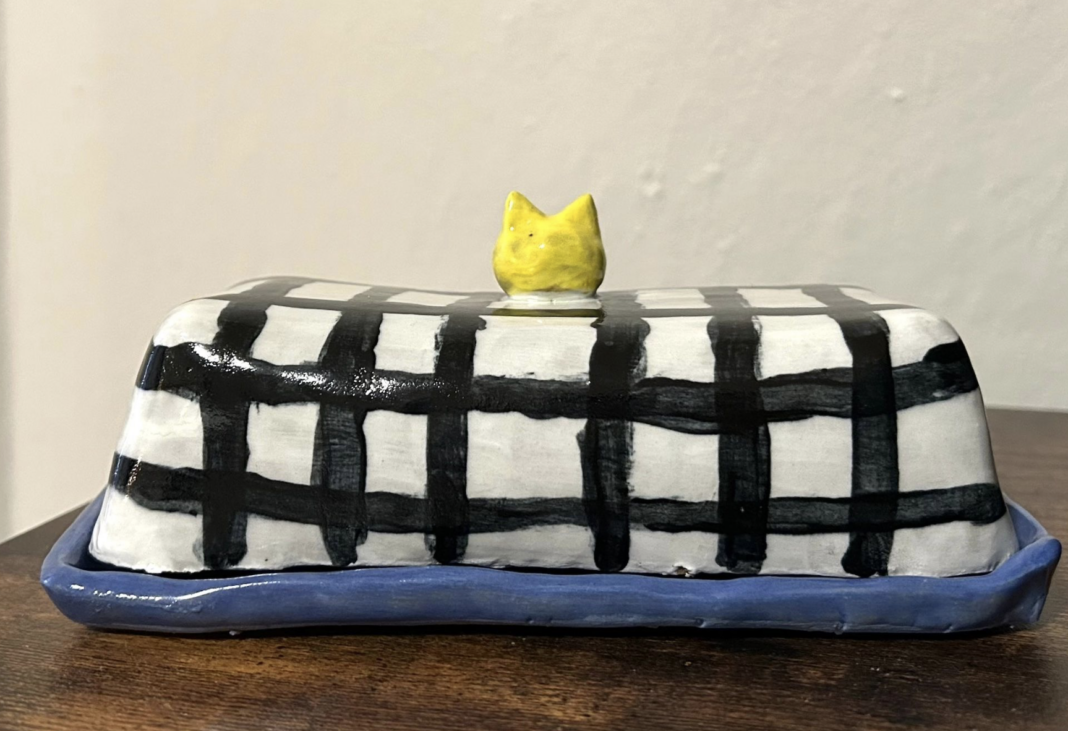
The bottom piece sat covered in clean light blue paint. The top wore a triple coat of fresh white. And perched on the lid, a tiny yellow cat head with painstakingly symmetrical ears kept close watch – despite lacking eyes.
All that remained were the black lines that would create a checkered pattern across the white lid.
It should have been simple. Just draw straight lines. But my hand wouldn’t cooperate. Each stroke emerged thick and wobbly, carving irregular paths across the surface. The lines were supposed to be crisp and neat. Instead, they looked like they’d been drawn during an earthquake.
“I shouldn’t become a surgeon,” I joked out loud, trying to laugh off my disappointment.
When I signed up for the Jan. 14 class, I had a pretty good idea that pottery would be a challenge. Not because it’s technically difficult, though it is, but because it demands something I struggle with: accepting the uncontrollable.
Walking into the studio that evening, I took in the space. Two wooden tables, dusty from clay, filled the center of the workshop. Shelves lined the walls, crowded with finished pieces in brilliant glazes. Students chatted easily around me as I settled on my stool and got acquainted with my materials: a needle tool for carving, a rib tool for smoothing, vinegar mixed with water for joining edges.
We would not be throwing anything on a wheel, something I’d half expected but fully feared. Instead, we started with pre-cut clay slabs and laminated butter dish templates.
We began by smoothing both sides of our clay with the rib tool, working out any bumps and ridges. Then came the tracing – placing the templates on top and guiding the needle tool around their edges to cut the shapes that would become our butter dishes.
Our instructor, Semele, walked us through scoring (making shallow scratches where pieces would connect) and slipping, brushing on a vinegar-water mixture that would act as adhesive.
She made it look effortless. I fell behind almost immediately.
While others moved on to decorating, I was stuck smoothing my seams, hunting for imperfections in the clay’s surface with the focus of someone defusing a bomb. A tiny indentation would appear, and I’d run my fingers along it, only to create a new one somewhere else. It was like trying to catch water.
An hour and a half in, when I had smoothed and shaped ad nauseum, my pieces finally fit together properly. Semele confirmed they’d survive the kiln – she actually assured me more than once – so it was time to add personality.
We were given the option to carve designs into the clay or shape small objects to attach as decoration. Some made flowers, others leaves and fruits. I decided to form a small cat head to serve as the knob on top of my butter dish, a nod to my cat, Mabel.
I shaped the head. Smoothed it. Attached the ears. Spent twenty minutes making sure both ears were exactly the same size and shape, because if they weren’t, what was even the point?
By the time I got around to painting, I had settled on a vision. I’d found a photo online of a butter dish with a black and white checkered pattern on the lid: clean, striking. That would be mine. Light blue on the bottom, white on top, the cat head in yellow, and those crisp black lines creating perfect squares.
But then came the paint, and with it, the reality I’d been avoiding.
The blue bottom went on fine. The white top, smooth. The yellow on the cat head? No problem. But those black lines, the ones that were supposed to match my inspiration photo, came out thick and wobbly; not even remotely as thin or straight as I’d envisioned. My hand simply refused to hold steady.
It was hard to fight the voice telling me that all my effort had been for nothing. That the hours of careful smoothing meant nothing next to twenty seconds of wobbly brushwork.
But sitting there in the pottery studio, the last one working as others packed up, I realized that was the lesson I’d been trying to avoid. Not everything can be controlled into perfection. Sometimes your hand shakes. Sometimes the clay cracks. Sometimes the lines come out wrong, and you have to live with it.
The checked pattern on my butter dish lid is wonky and uneven. The cat head’s ears probably aren’t identical, despite my efforts. The whole thing may not even survive the kiln.
But it’s mine. I made it with my own hands, in the company of seven strangers who became collaborators for three hours. I made it while my shoulders tensed up so badly that they were sore days afterwards. I made it while learning the vocabulary of scoring and slipping, while discovering that vinegar can join clay, while understanding that creation demands all of your attention in a way that feels like mercy in a world of constant distraction.
Taking stock, I admit I felt a bit of pride.
I’m already planning to go back. Not because I’ve mastered letting go of perfection, but because I need more practice at the art of trying. At being able to learn, over time, that my creations can be imperfect – and that’s what makes them mine.