
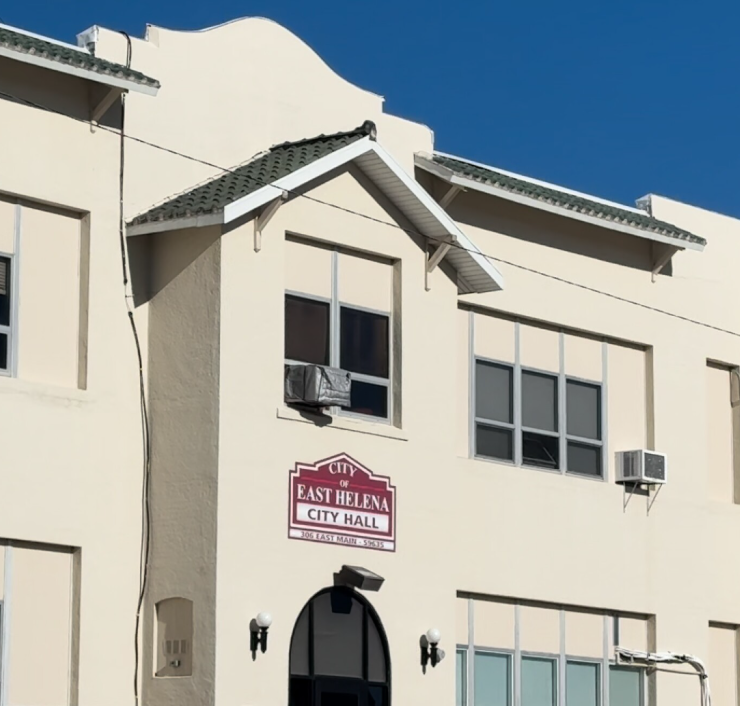
East Helena’s four-member City Council voted last month to remain part of the Missouri River Drug Task Force, which has begun cooperating with locally based U.S. Border Patrol agents, as detailed in a recent task force memorandum.
Local officials, however, have taken varied stances on the decision. Council member Suzanne Ferguson, who cast the lone dissenting vote, declined to comment. But fellow Council member Don Dahl expressed concern about working with Border Patrol, which many view as closely tied to Immigration and Customs Enforcement, or ICE.
“If I were voting for myself, I would’ve voted no because of immigration,” he said. “The only reason that I didn’t vote against the memo was because anybody who contacted me, it was all ‘We should be joining that force.’”
A broad coalition of local and federal agencies, the task force works to halt drug and human trafficking across much of Southwest Montana. Its January memo, which mainly outlines the Border Patrol’s task force cooperation, prompted the Helena Police Department to withdraw from MRDTF, citing local concerns about increased Border Patrol activity within the Capitol.
(On Feb. 11, state authorities launched an investigation into Helena’s decision to advise its police officers to avoid assisting federal authorities with immigration enforcement.)
Both ICE, which is unconnected to the task force, and the Border Patrol (officially U.S. Customs and Border Protection) are part of the Department of Homeland Security. But they have rather different mandates: ICE focuses on internal immigration enforcement, while the Border Patrol aims to secure and enforce U.S. borders.
The Border Patrol has worked with the MRDTF since the latter’s 1990 launch, but its agents had never been stationed in Helena or Bozeman – until now. Despite the Helena PD’s withdrawal from the task force, two Border Patrol agents are now working out of the MRDTF’s Helena office, as outlined in the memo.
Officials expect them to work only on drug enforcement and refrain from calling upon local officials to aid in immigration enforcement activities. East Helena contributes $4,000 to MRDTF each year to help cover equipment and operating costs. In return, the city receives information about federal drug stings and operations conducted in their jurisdiction.
East Helena residents spoke for half an hour at the Jan. 20 meeting, almost unanimously in support of task force and Border Patrol cooperation.
“Anything that we can do to keep drugs from our kids,” said Denise Feller. “We like that, as a community, that they can come in and help us get rid of drugs in East Helena.”
“I think it’s super important that we as a government operate in their capacities,” said Mayor Kelly Harris, referring to residents’ clear support for the task force.
The specter of Minneapolis and the two citizens killed, one by ICE, another by a Border Patrol agent, hung over the MRDTF discussion. Local law enforcement officials insist that their officers cannot perform immigration enforcement.
“I was a little bit concerned about liability issues, just with everything that’s going on throughout the country,” East Helena Police Chief Ed Royce said in an interview early this month. “We don’t want any of that type of situation here.”
Lewis & Clark County Sheriff Leo Dutton also noted the troubles in the Midwest, but felt confident continued communication through initiatives like MRDF could deliver better results.
“There’s cause for concern out of Minnesota, and I hope they fully investigate that and deal with the outcome,” he said in an interview. “But because we’re up front and we’re having conversations about what we’re going to do here and how we’re going to do it, it alleviates a lot of that confusion.”
For Dutton, federal collaboration gives East Helena and other cooperating agencies the opportunity to express their concerns and be heard.
“One of the best ways to participate and protect your community is to have a seat at the table, and if you have concerns you want to be there to voice them,” Dutton said. “Federal agencies can come into our town, our county, anytime they want. But because of cooperation and communication, we have a seat at the table.”
Royce expressed a commitment to taking on drugs in East Helena, and City Council member Wes Feist saw task force cooperation as a key part of that effort. “If we did not sign this MOU we would have been placing our community at risk without having the ability to properly investigate the drug and human trafficking crimes,” Feist said.
Royce insisted East Helena police could not and would not aid in any immigration enforcement efforts as part of their task force involvement. Dutton concurred, adding that local law officers are not authorized to perform immigration enforcement.
“You can’t ask us to break the law,” he said. “We can’t, we don’t do immigration. So no, they would not do that.”
Police officers across the country have aided in ICE raids through the 287(g) agreement, which enables local agents to identify, arrest, and process people for immigration enforcement purposes.
Yet as of Feb. 11, neither East Helena nor Lewis & Clark County had signed on to 287(g), making it illegal for local police to aid in immigration enforcement. Gallatin County, where the other two Border Patrol agents are stationed, has agreed to embrace 287(g).
East Helena officers could be called on by Border Patrol or other participating agencies to aid in a drug bust involving immigrants. But Dutton frames those cases as the enforcement of alleged criminal acts (selling or transporting drugs or people across the border) rather than civil, immigration-related offenses (crossing the border without proper documentation).
Dutton said the MRDTF had been requesting a strong agent presence for several years. Border Patrol agents are required to be proficient in Spanish, which Dutton said could be useful in instances where someone cannot speak English. He also expressed hope that having Helena-based agents dedicated to drug and human trafficking could combat Montana’s emerging drug issues.
In recent years, state investigations have found that Mexican drug cartels have begun targeting rural Montana, with a focus on the six Native American reservations.
“I am wholeheartedly behind [the task force] and their mission,” said Chief Royce. “Let’s get the drugs off the streets.”