
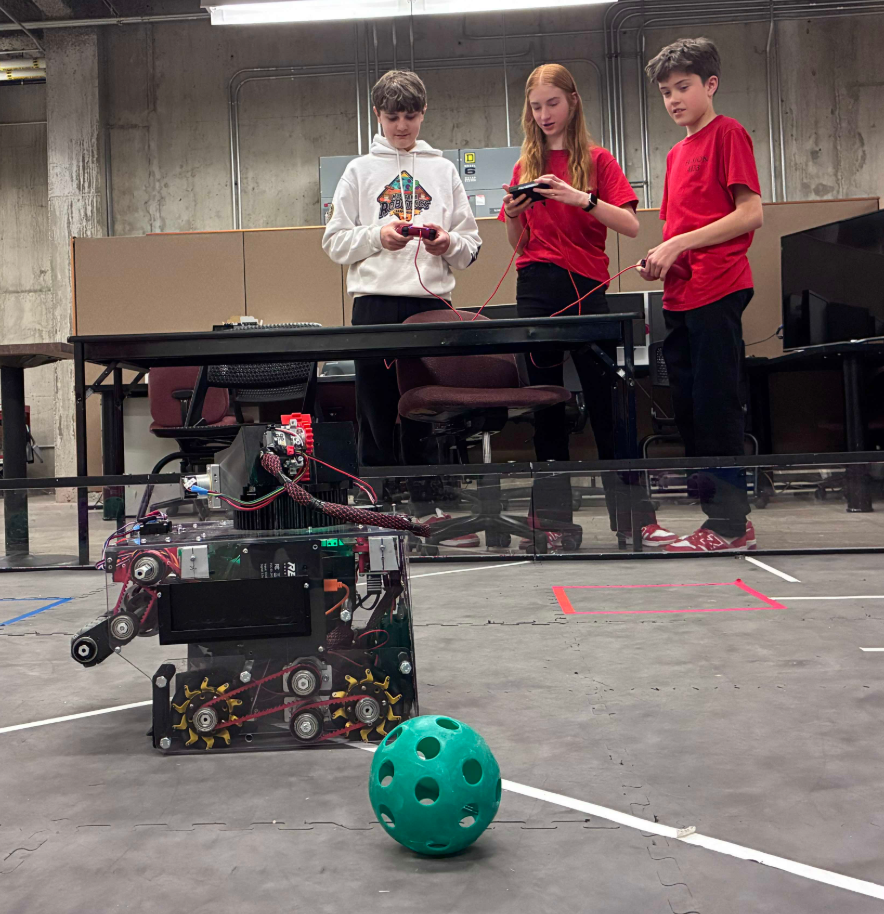
East Helena High freshman Samantha Bartow had been involved in robotics for two years when she began to sense her ambitions – and the possibilities.
“We were one placement away from qualifying for Worlds,” said the now 14-year-old, recalling a 2024 competition. “That was kind of my first, like, eye opening: ‘Oh, Worlds is a possibility.’”
Today, Bartow is one of seven Helena-area students on team Fusion 4113, which is headed to Houston April 29 to compete in the For Inspiration and Recognition of Science and Technology (FIRST) championship, a premier international youth robotics competition that attracts as many as 1000 teams from around the globe.
Friends and classmates give a nod of respect when they see her working on a robotics report or making mechanical calculations – connecting her to her engineering achievements. “It’s like, are you working on robotics?” Bartow said. “It’s definitely cool to be that.”
Founded by inventor Dean Kamen, FIRST is the world’s largest youth robotics organization and its annual championship, known simply as “Worlds”, brings together competitors from age five to 18. Bartow and Fusion 4113 are in FIRST’s Tech Challenge (FTC), in which their robot must meet exacting specifications and perform certain tasks.
FTC releases instructions every September – this year the goal is putting plastic balls into a hoop – and teams spend the next nine months building their robots, entering them into competitions, and refining as they find gaps and advantages. More than 330 teams are set to compete in the FTC in Houston this year.
Bartow, whose family lives in Canyon Ferry Crossing, has always been gifted in STEM: she took sophomore-level geometry while in 7th grade. Even before that, rarely feeling challenged, she started looking outside the classroom for inspiration around the fourth grade.
She took part in East Helena area robotics camps and, at the urging of coach Kinsey Vavruska, joined the First Lego League (FLL) at age 12. FLL is a Lego-focused Helena robotics team for elementary students and early middle schoolers.
Burrow was delighted to learn new skills. “Both my parents are engineers, and I have family who are teachers, so [I have] this lifelong love of learning that I’ve always had as a child,” she explained.
Starting to participate in robotics and seeing the goal of the FIRST championship gave Bartow a sense of direction. Once she realized she was doing engineering work she decided, “this is what I want to do with my life.”
She quickly distinguished herself as an FLL leader. One key contribution was the addition of an evaluation and review report, called a portfolio, to gauge project progress. Previously, only middle school and high school programs had performed this sort of review.
“It was pretty obvious watching Samantha when she was in the FLL program to see that she was on the ball,” said Fusion coach Dan Janowski. “She was well motivated, all the kind of traits that we look for when trying to recruit team members…She’s, in a lot of ways, the ideal candidate for a robotics team.”
Bartow carries herself with self-assured confidence; her sweet smile already includes a hint of authority. Yet she’s no show-off, and her passion for mathematics and robotics are unmistakable. Janowski and other coaches started recruiting her even before she’d aged out of FLL.
“They made an effort,” Bartow recalled, so she signed on to the highly accomplished team.
Founded in 2010, Fusion 4113 is the Helena area’s oldest FIRST Tech Challenge team. It has won a first or second place Inspire Award – judged on outreach and community impact, connections to other teams and robot design and programming – in 10 of the last 16 years.
In terms of community impact, a few years ago Fusion developed chemical storage and organization trays for Helena airport TSA agents that helped the airport qualify for the Lift Cell innovation program, a designation usually reserved for larger airports.
The team is unsure what makes them especially successful, resorting to platitudes about work ethic and collaboration when asked. But watching Fusion members scurry about to show their robot’s abilities, or work together on a problem, their meaning is clear.
Finding a stripped nail they couldn’t budge, Bartow and teammate Colton Berg have a brief back and forth on how to extract it, passing the screwdriver between them as they do. There’s no ego; they’re just focused on solving the problem together.
“We like being best friends on this team,” said Cyler Duskrin, a Fusion programmer. “I think a good team also needs to have disagreements.”
Bartow agreed. Initially, the team had two robot designs, which began to pull the team apart as each group insisted its design was better. Ultimately, they decided to pool their ideas.
“We learned that we were stronger if we combined our ideas into a robot that put some of the good of each into it,” Bartow said, “This robot was the result of that.”
Bartow appreciates other STEM lovers willing to put in the work. Her team spends around 10 hours a week working on their robots, in addition to time spent on portfolios, research, and community outreach at home
“It amazes me just how much work I see everyone on the team put in,” she said.
Female representation in STEM fields and robotics is on the rise, with more than 50% of college science and engineering degrees attained by women. Yet gaps remain in the workforce.
Women make up nearly half of the labor pool (48%) but hold just over a third (35%) of STEM-related positions, according to a March report from the National Girls Collaborative Project.
Bartow, one of two girls on the seven-person Fusion squad, sees no gender issue within team dynamics. For her, robotics is a welcoming world – it’s just that few girls are aware of it.
“They just don’t know that it’s an option, that they can do this,” she said. “They’re more than capable. There’s so much to learn, and it’s really, really fun to get to know all kinds of people. I’ll always encourage more girls to go into STEM.”
Bartow considers Kathleen Cook, Fusion’s former programming lead and team captain, her role model. Cook is now studying computer engineering at Montana State. More than 6 out of 10 students who participate in FIRST go on to earn degrees in engineering, according to the organization’s website.
Bartow intends to be one of them. She dreams of becoming an aerospace engineer. “Anything that flies has always inspired me,” she said.
Looking ahead to Houston, rather than worried about proving herself on an international stage, she’s excited to visit the Johnson Space Center. She looked forward to competing at FIRST, but her eye is fixed on further horizons.
“This is gonna get me ready for my career,” she said. “Everything I’m doing here is gonna help me in the future.”