
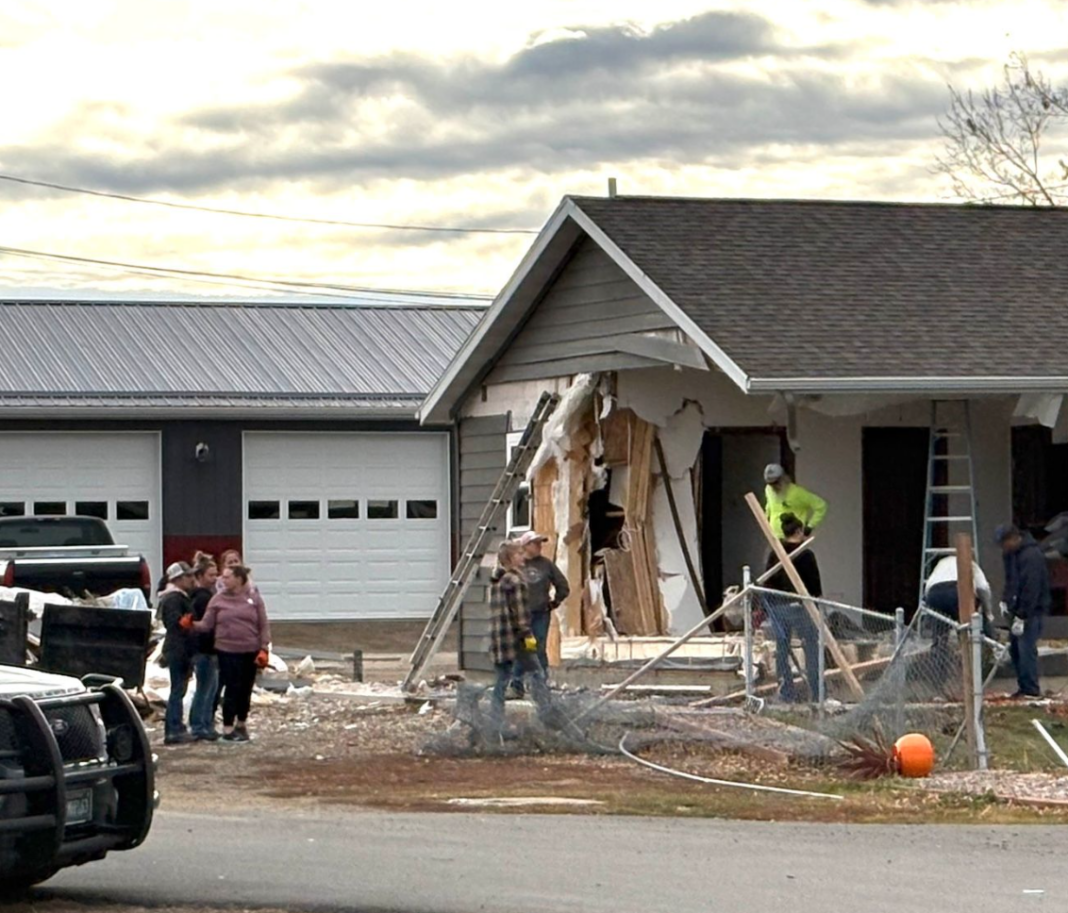
Months after a deadly drunk driving incident inspired the creation of a new state criminal offense, a tragically fatal East Helena accident looks set to put Montana’s newest bit of traffic justice to the test.
On the night of Saturday, Nov. 22, William Bart Stuart reportedly climbed into his Audi A7 with a friend after drinks at the Lakeside bar on Lake Hauser. Minutes later, he was pulled over by Montana Highway Patrol troopers on Lake Helena Drive, on suspicion of driving under the influence.
The passenger exited the vehicle before Stuart sped off, according to the MHP, heading southbound on Lake Helena Drive toward East Helena. The MHP gave chase toward Old Highway 12, aka Main Street, where Stuart, driving at high speed, failed to negotiate the intersection, smashed through a chain-link fence and crashed into a home, killing a 69-year-old woman and putting a 76-year-old man in the hospital with serious injuries.
The passenger, who has not been named, later told police that the 52-year-old Stuart, who lives in Helena and owns an auto body shop called The Wreck Room, had had 14-15 drinks at Lakeside. This, unfortunately, did not stop him from getting behind the wheel – nor did his five previous DUI convictions, which resulted in multiple jail sentences and license suspensions.
The result was a vehicular missile that, witnesses told investigators, “flew” into the Main Street home at up to 70 miles per hour. Might the court now – finally – throw the book at this deadly recidivist and keep him off Montana roads for good?
House Bill 267, passed earlier this year, established a three-year minimum sentence for the new crime of aggravated vehicular homicide while under the influence, and enabled judges to levy a sentence of up to 30 years.
Widely known as Bobby’s law, the bill was inspired by the death of Bobby Dewbre, who was out celebrating his 21st birthday in Columbia Falls in March 2023 when he was struck and killed by a drunk driver while crossing the street.
“Passing this law means my son didn’t die in vain,” Beth McBride, Bobby’s mother, said after the bill passed in April. “It’s going to be a better, safer place for all Montanans.”
The next month, the man driving the vehicle that killed Bobby, John Lee Wilson, walked out of prison a free man. Convicted of three misdemeanors, he had been sentenced to 18 months in November 2023. The reason for the seemingly light sentence was that Wilson was not speeding or swerving at the time of the accident. As a result, the prosecutor could not prove negligence, which would have enabled a felony charge and a harsher punishment.
Bobby’s law removes the requirement of proving negligence to bring a felony charge on DUIs, essentially asserting that being behind the wheel at double the legal blood alcohol limit or with previous DUI convictions is negligent. This does not apply in the case of Stuart, because after three DUI convictions any further convictions are automatically felony charges. But the longer potential sentence outlined in Bobby’s law could apply to Stuart’s case.
Still, the question the East Helena victim’s family is likely asking itself today is how is it that a man with not one or two but five previous DUI convictions – including four in his first decade of legal drinking age – was still able to legally drive in Montana, and able to get behind the wheel and start his car while intoxicated?
It defies logic and public safety that his license had not been permanently revoked, nor had an ignition interlock system been permanently affixed to his vehicle. So, how could this happen?
The easy answer is that no U.S. state has a worse drunk driving problem. Montana scored a perfect 100 on six drunk driving metrics compiled byForbes earlier this year; no other state scored a 99 (South Dakota came in second at 98.78).
The Treasure State has the highest rates of drunk drivers involved in fatal crashes (8.57 per 100,000), people killed in crashes involving a drunk driver (7.14 per 100,000), and drunk drivers under 21 involved in fatal crashes (1.17 per 100,000), and the highest share of traffic deaths caused by drunk drivers (43.5%).
This perfect storm of failure is likely a result of notoriously weak punishments. In 2019, Mothers Against Drunk Driving, the U.S.’ top anti-drunk driving organization, labeled Montana the worst-performing state in terms of its efforts to curb drunk driving. The case files from Stuart’s most recent DUI conviction, in 2010, seem to bear this out.
On the evening of January 26 that year, MHP Officer Ben Havron saw a truck parked along the north side of Highway 12 headed west toward Helena, with a man standing next to it, and pulled over to offer assistance. “Officer Havron observed that the man, later identified as William Bart Stuart, had difficulty maintaining his balance and appeared to support himself by leaning against the vehicle,” says the 2010 affidavit.
“Stuart offered that the driver of the truck had fled the scene of the accident,” the report continued. “The only footprints Officer Havron could find led from the driver’s side door to the place at which Stuart was standing.”
When Havron asked him who had been driving the truck, Stuart again denied he had been behind the wheel, so Havron put him into the back of his squad car. Havron detected the smell of alcohol and noticed that Stuart was slurring his speech and had difficulty keeping his eyes open.
Stuart repeatedly refused both a field sobriety test and a breath test, including after they reached the station. “When Officer Havron searched Stuart’s criminal history,” the report concludes, “he discovered that Stuart has four previous convictions of driving under the influence of alcohol.”
That July, the judge sentenced Stuart to five years in prison and suspended his driver’s license for three years following his release. Montana law enables judges to enforce a long-term or even permanent license revocation on the fourth DUI conviction, or on subsequent convictions.
But despite four previous DUI convictions and his repeated lying to the officer, which could have qualified as further crimes of making false reports and obstructing justice, Stuart walked out of prison in 2015 and was able, by 2018, to have a few drinks and get behind the wheel.
Jessica Wilkerson, a Helena defense attorney specializing in DUI briefed on Stuart’s history, saw his 2010 punishment as reasonable given the offences. But ten years later, an East Helena family suffered a shocking and devastating tragedy as a direct result of the court’s leniency.
Now Stuart faces felony counts of criminal endangerment, vehicular homicide while under the influence and fleeing a peace officer causing serious bodily injury or death. Wilkerson expects him to be sent to prison for a long time, yet doubts that harsh individual punishments will solve Montana’s drunk driving problem.
“We could put people in prison forever, it’s not going to change things,” she said. “We need to start figuring out why people are drinking in a destructive manner and start addressing that as a society.”
This seems wise, but it’s hard to imagine such a sea change anytime soon. Meanwhile, Montana has in recent years moved toward somewhat tougher policies. In 2021, the state amended its DUI law to recognize a legal limit for cannabis intoxication. And earlier this year came Bobby’s law.
That new law cannot bring back the woman, possibly a mother and grandmother, that Stuart killed last month, or give her family any real sense of justice. But it could deliver a harsh punishment that forever eliminates this single threat while persuading future potentially homicidal drivers to hand their keys, again and again, to a sober friend.
That seems a good place to start.