
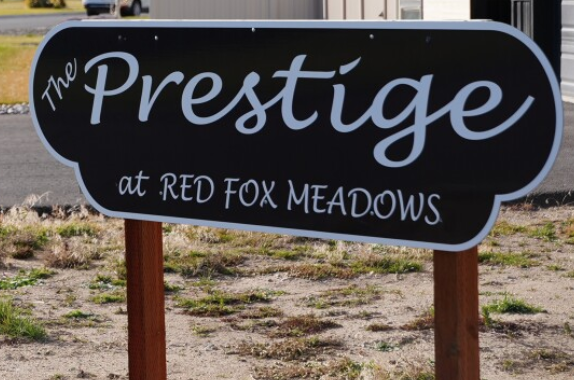
Along Canyon Ferry Road just south of the Helena Valley Reservoir sits The Prestige at Red Fox Meadows, a sprawling East Helena subdivision of nearly 30 homes that began welcoming residents last year.
Everything seemed fine until October, when homeowners received a letter informing them their housing development would be denied its expected water rights and that every home in the subdivision would need to find a new water source, likely at considerable cost.
“Some of us just bought these homes,” said Prestige resident Jen Miller, a nursing instructor and mother of five who moved into her new home in June. “If we’d known this was a problem, a lot of us would not have bought.”
The trouble at Prestige, and a dozen other housing projects across the state, stems from a February 2024 court ruling barring the state’s Department of Natural Resources and Conservation from approving so-called exempt wells as water sources for new developments.
Judge Michael McMahon argued that the state agency had misused exempt wells – a designation originally intended for agricultural purposes and thus exempt from water impact analysis or water right holder impact reports – to green-light projects without performing a full water assessment. The problematic result is that water use at these developments may now threaten to impinge on nearby water sources.
Along with their developer, Prestige residents, who at least for the moment are able to keep using their water, are left wondering what might be next. At a Nov. 5 public meeting, DNRC Water Resources Administrator Anna Pakenham Stevenson laid out a few possible solutions.
The first option is to connect Prestige to East Helena’s water system, which appears to be prohibitively expensive. Such a project “would cost millions,” says East Helena Public Works Director Kevin Ore, if it’s even possible.
While Red Fox Meadows is part of East Helena’s septic system, it’s just outside the city limits, which means residents would likely have to appeal to the City Council to annex the subdivision, according to Ore. Yet even that might not solve the problem.
“Typically, to annex something like the borders, you have to touch, right? You can’t have a chunk of county land and a space that doesn’t touch,” said Ore. “So, I don’t even know legally if [annexation to connect to city water] is an option for them.”
There’s also the fact that East Helena may not have any water to spare, given that the state recently refused to grant the city the water rights for the former ASARCO smelter lands, where developers hope to build some 6000 homes in the next 20 years. “We’re facing some water shortages with our current growth that we’re projecting,” Ore acknowledged.
Potential remedy Number Two is to apply to the DNRC for beneficial use (meaning the water is put to use in a way that benefits an individual or society) and mitigation permits, which would, in essence, enable Prestige to relocate an existing water right from a senior holder. That process, which would begin with the hiring of an engineer, a water consultant and probably a water rights attorney, would likely cost thousands of dollars.
The DNRC offers to help applicants assess their advisory needs, which could reduce expenses. At the Nov. 5 meeting, the DNRC advised Prestige residents to apply together and split the costs.
A representative of Hamlin Construction and Development, the developer of Red Fox and Prestige, said the firm had hired a water rights attorney to assess possible solutions with residents. But resident Miller expressed doubts about getting everybody aligned.
“A combined permit really could work, but it will require us banding together,” she said, adding that it would require considerable coordination.
The third option is legislation, which could come in a variety of forms. Sen. Mary Ann Dunwell, who represents East Helena, has called on the Legislature’s water committee to sponsor a bill that would grandfather in water rights for the 12 subdivisions across Montana facing this issue.
As detailed in her op-ed in this newspaper (See page 4), she also proposes a special revenue account to address water mitigation issues. “Our Legislature failed,” Dunwell said at the Nov. 5 DNRC meeting, drawing the evening’s only applause. “Our Legislature has to act.”
Guy Alsentzer, head of Upper Missouri Waterkeeper, the environmental advocacy outfit that successfully sued the DNRC on exempt wells, similarly blamed the legislature. Yet he also brought up a 2014 ruling, later affirmed by the state’s highest court, against the DNRC. “The Supreme Court, over a decade ago, told them ‘You cannot do this. You cannot give away exempt well after exempt well’,” Alsentzer told The Monitor. “Instead, they did the exact opposite.”
House Bill 358, which sought to grandfather in water rights for existing homes to avoid costly water mitigation, failed in the 2025 Legislature. But the DNRC worked with lawmakers this year to pass House Bill 681, which ensures a thorough water analysis is performed at the earliest stages of subdivision development and goes into effect next year.
Prestige residents seemed to view the legislative option as the best path, though likely to take time. “I don’t have a lot of faith that a legislative action is going to happen quickly, unless we get a lot of community members behind it,” Miller said, adding that she had begun rallying residents.
Those likely to support Miller’s effort include resident Cindy Moccio, who sent a letter to Governor Greg Gianforte on Nov. 13. “Your support in obtaining our water rights for a home we have lived in for 18 months before we were notified by the DNRC that an application submitted on May 20, 2024 was denied,” Moccio wrote, “would be greatly appreciated.”
Residents of East Helena – a state-designated closed basin, which means it’s nearly impossible to acquire new water use permits due to existing water rights protections – may find the water issue unavoidable in the weeks ahead. In addition to the ASARCO water rights and Prestige, the nearby Kamp Major and Grand Vista subdivisions also face the exempt well problem.
This helps explain why on Nov. 12, a coalition of landowners, conservation groups, and municipalities filed a Lewis & Clark County complaint accusing the state of enabling the exempt well loophole to potentially endanger the state’s water resources.
“Despite the recognition that basins in high-growth areas are fully appropriated,” the plaintiffs argued, “the State continues to authorize these exempt wells without public notice, mitigation requirements, or evaluation of potential effects on existing water rights or surface flows.”
In the coming years, exempt wells and water rights are likely to be at the heart of the growing tension between Montana’s beloved open spaces and encouraging much-needed homebuilding.
“We have to grow within our means,” said Alsentzer. “Rampant speculative sprawl…is going to have dramatic negative consequences for our outdoors-based economy, for our wildlife and for existing traditional land use patterns, including agriculture.”