
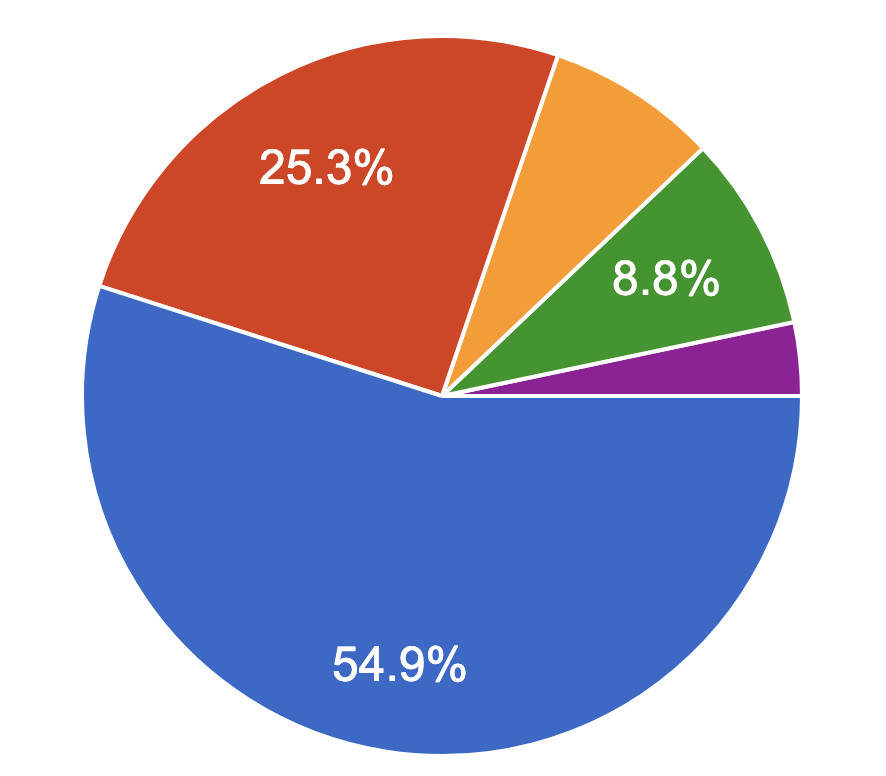
In early March,The Monitor surveyed East Helena residents about the proposed Rose Hills and Prickly Pear Estates developments and the city’s looming, potentially exponential population growth. Among the more than 90 respondents, nearly three of four expressed support for some level of East Helena growth, but most had reservations. (Find the full survey results here.)
About four out of five expressed concern about the impact on community character, and a similar number expressed concern about the city’s water supply. To gain better insights, three survey participants agreed to speak to The Monitor and explain their views in more detail.
If you have something to say about East Helena’s growth plans, please reach out us at info@boulder-monitor.com. For this article, The Monitor spoke to:
Rebecca Schwartz, 42, who moved to Highland Meadows in early 2025. Schwartz works as the Executive Director of Strategy, Innovation, and Effectiveness at Carroll College and has 3-year-old twins.
Kenn Winegar, 59, who has been a resident of East Helena for 20 years. Winegar works as a fiscal planner for the state and has two adult children, 28 and 30 years old.
Craig, a civil service worker in his 40s who has lived in East Helena for just over 10 years and raised two children in the community. He preferred not to share his surname.
Community character
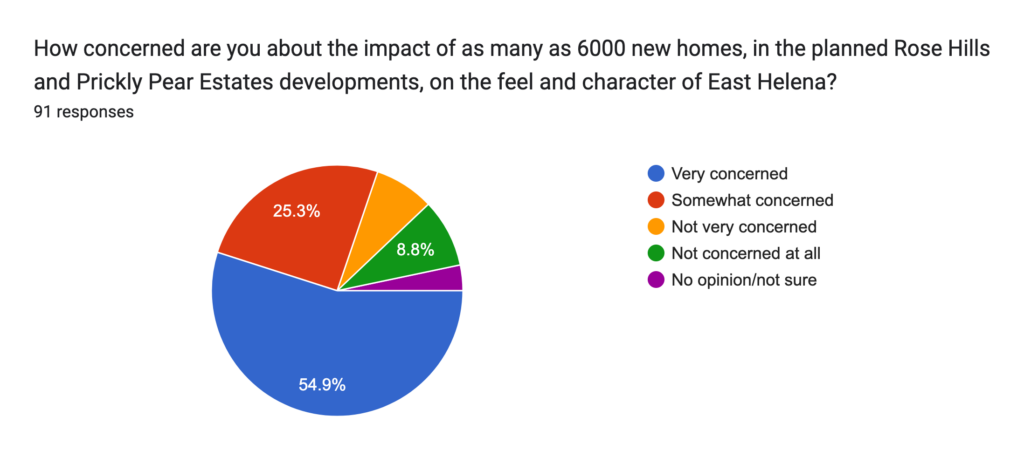
We asked how concerned residents were about the impact of as many as 6,000 new homes on the feel and character of East Helena. About 55% said
they were very concerned, and another 25% said they were somewhat concerned – meaning roughly 80% of respondents expressed some level of concern.
“Every time there’s an event, the turnout is insane. Halloween, the streets are full. The movie nights in the park, people really turn out. There’s this really big community involvement that happens in a city where I have to go into city hall to buy my dog’s registration because none of it can be done online…I worry that this charm, this small town feel, this history that East Helena really enjoys, will not survive the influx of people that it’s being designed specifically to bring in.” – Schwartz
Water
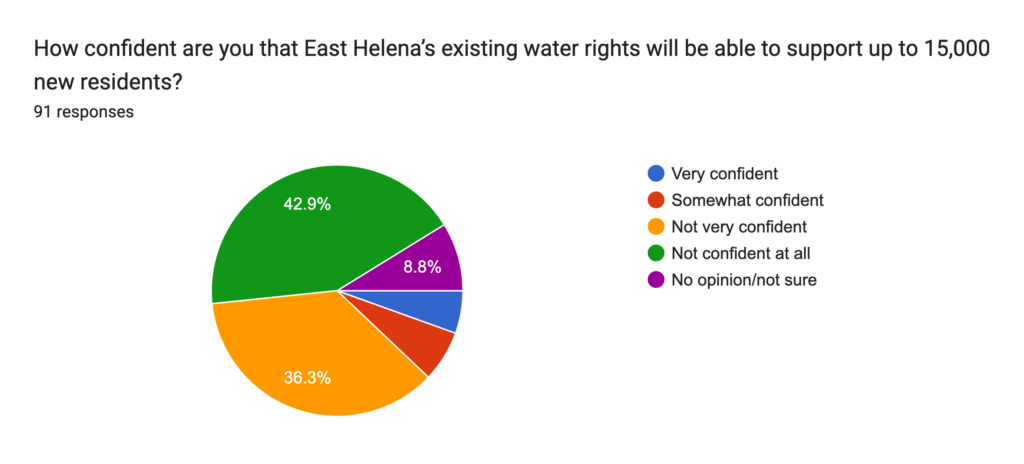
We asked how confident residents were that East Helena’s existing water resources could support up to 15,000 new residents. Nearly 43% said they were not very confident, and another 36% said they were not confident at all. Just under 9% said they were very confident.
“I have zero confidence that engineers have worked on it to satisfy the new houses, or what happens in an emergency drought situation, or what if the engineers got it wrong…Is there even a backup plan? I would doubt that there is…I have zero confidence.” – Craig
“In the last year, water issues have come up…They were hoping to buy some water from Prickly Pear Creek, and that fell through.” – Winegar, who also said East Helena had never previously faced any water trouble.
“Between March and July, so many more houses were put up [at Highland Meadows] that the water system no longer had enough pressure…In five years we have an almost doubling of our population, which is what they’re planning to build. That’s a pretty big strain on a very finite resource…I just don’t think there’s enough water to go around…There’s lots of homes that are over 100 years old. They have wells. It’s not going to be fair when those run dry. And I think they’re going to run dry.” – Schwartz
Traffic
“If I go to leave my house at quarter to eight, I can sit in my driveway for 10 to 15 minutes before I can even get out on the road….Are they going to put two or three stoplights in town where they need to be, where they have a wreck once or twice a week right now, where they never used to before the schools were put in? Are they even looking at that?” — Craig
“Traffic kind of has an impact on me because I ride my bike to work, about four miles. Used to be, as soon as I got over the bridge I could book it. Not anymore. Too many cars come out there, and they’re not looking my way.” — Winegar
“Why didn’t the city or the county buy the easement to connect Plant Road to Wiley so people could have two ways out of that housing development? I called and talked to someone from the city and he just shrugged his shoulders and said, ‘It’s private property, we can’t do anything about that.’ Yeah, you can. Pay the guy fair market value, see if he’ll sell.” — Craig
Infrastructure and services
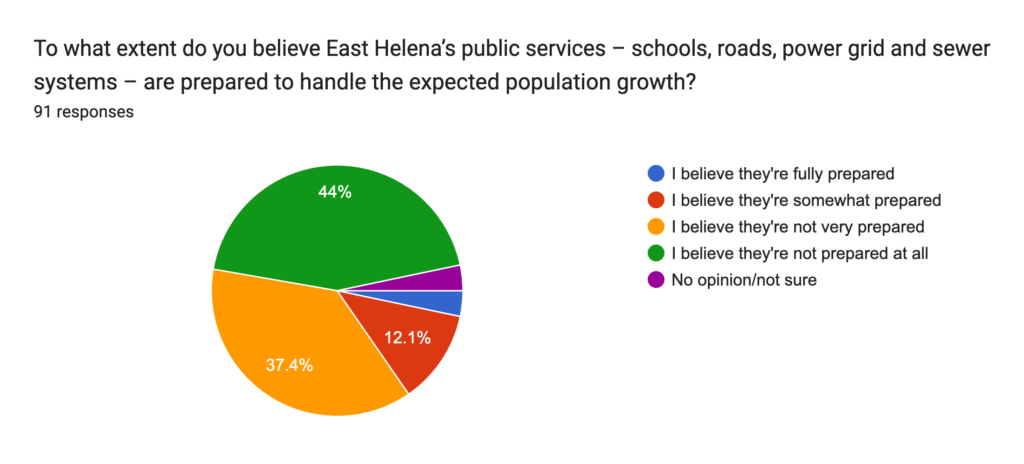
We asked to what extent residents believed East Helena’s public services – schools, roads, power grid, sewer system – were prepared to handle the expected population growth. About 44% said they were not very prepared, and another 37% said not prepared at all. When asked to identify their single greatest concern about growth, more residents chose the strain on public services than any other option, at more than 40%.
“Bringing in 1,000 houses is a lot of kids. How are they going to handle the influx of all these new school-age kids? I don’t think we have empty classrooms to put them in. We’re still paying for the high school and the grade school…You can’t put 1,000 people here, 2,000 additional people, and we can just absorb it. The community only has, I think, 3,000 or so people – and you’re going to increase it by 50%, 60%. How does the infrastructure handle that?” — Winegar
“The city agreed to put the schools in before they had the money for the infrastructure, which is just stupid…The infrastructure here is for the size of the town 10 years ago. So if you increase the number of people without increasing the infrastructure, you’re just creating headaches for everybody involved…The pace [of growth] wouldn’t matter if the infrastructure and the people who pull the reins of society were on top of it, were planning for it, and were actually adjusting for it. But they’re not.” – Craig
“At the moment I think there’s like one snowplow in East Helena. We have to buy another one if we’re going to grow. There’s a lot of steps, and there is always in a development like this – it has to reach capacity, it has to surpass capacity, for the next stage to kick in. Which means we’re going to have a couple of winters of really poor snow plowing.” — Schwartz
Financing
We asked how residents felt about the city’s plan to use bond financing through a new state program to fund infrastructure for the new developments, with costs to be paid back over time by new residents, not current residents. About 36% said they were somewhat opposed and another 12% strongly opposed, for a combined 48%. About 25% said they somewhat supported the approach, and roughly 12% strongly supported it.
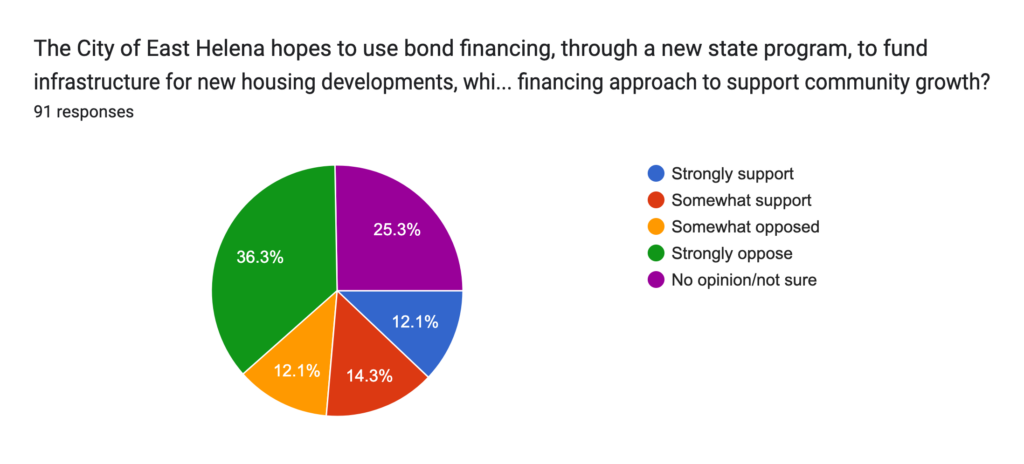
“If they’re going to target a specific area, show on a map where that area is. It was a little vague to me…I truly thought this was a bond that the city of East Helena was going to vote on that would impact all residents inside the urban boundary. That needs to be a little bit clearer when they talk about it.” — Winegar
“I would be highly skeptical that they would only charge this one housing development an assessment, because someone is going to raise their hand and cry equity. That’s not fair – and it’s going to be put on every resident of East Helena.” — Craig
What East Helena needs
We asked where residents stood on East Helena’s expected population growth. About 55% said they opposed residential growth in East Helena generally, and another 13% opposed the current pace or nature of growth. About 19% said they supported some growth but had significant concerns. Roughly 12% said they supported growth and the developments as proposed.
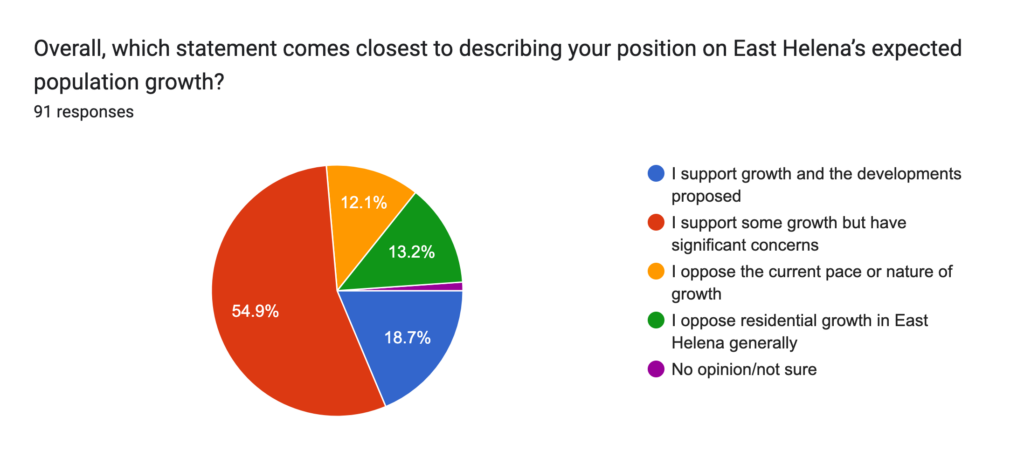
“I expect city officials to do their job. They just need to, once in a while, reassure us that they are – that they’ve done studies, they’ve looked at potential future growth, what those impacts are, and whether the community can absorb it.” — Winegar
“I wouldn’t characterize it as an opposition to growth. I would characterize it as an opposition to unmanaged growth by incompetent people who are not spending the money they need to spend figuring out what they need to figure out ahead of time…We need people with a can-do attitude, not people who are going to shrug their shoulders and say ‘not my job.’…Number one, elect competent people. Number two, hire competent people. Number three, town hall meetings — open, transparent, and available to the people.” — Craig
“I would like to see what the 10-year plan is for a new sewer system. I would like to see how they’re holding developers more accountable for creating sustainable communities rather than throwing up houses…I would like a more holistic review of the development applications. We’re putting up over 100 homes [in the Highland Meadows subdivision] – there’s no park. There is no addressing of increased water. There is no change to the sewer. It’s not just nearsightedness in terms of ‘there’ll be more revenue, so we’ll figure it out.’…Growth is inevitable, and I don’t think it’s worth trying to stop something that’s inevitable. But I would really want to emphasize that the spirit of East Helena is really great. We want to grow the community – not just the tax base.” — Schwartz