
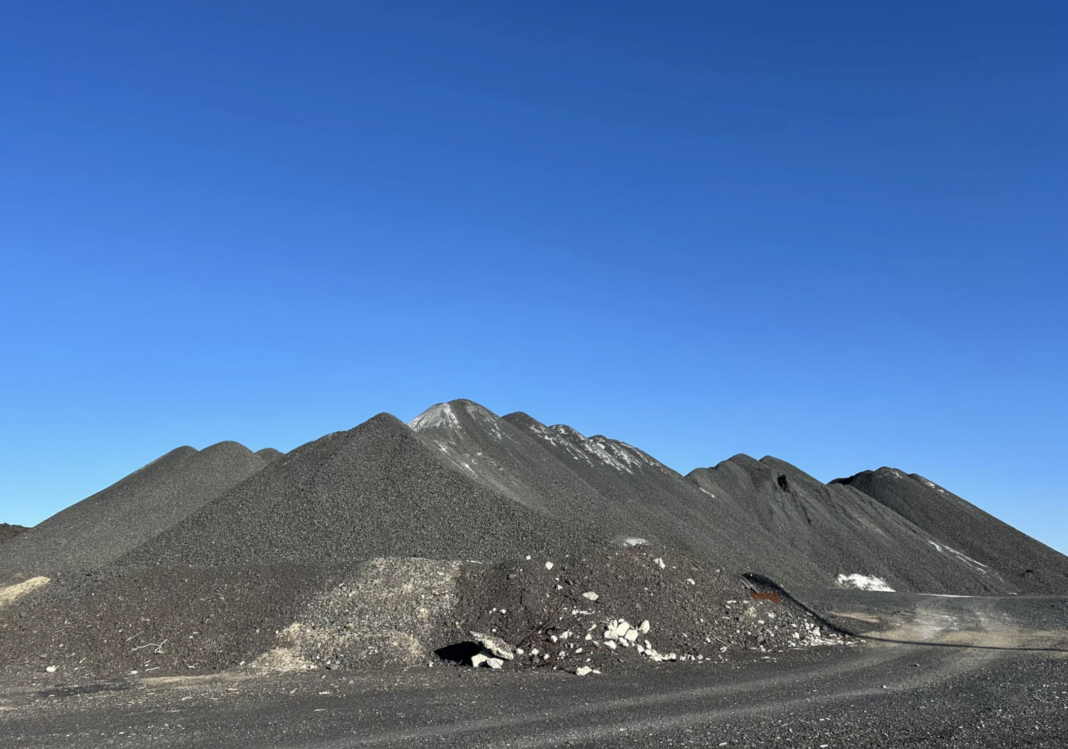
A broad black mountain dominates East Helena’s landscape, rising approximately 150 feet into the sky and often blotting out the winter sun, depending on your location. But what exactly is it, how did it get there and why does it still loom over the town?
The story starts in 1888, when the Helena and Livingston Lead Smelting Company opened a lead smelter on the banks of Prickly Pear Creek, where railroad tracks would soon be laid as a new town sprung up.
The Montana Territory – it wouldn’t become a state until the next year – remained wild, yet had for years been welcoming miners and prospectors looking to strike it rich, along with merchants after a smart buck. In 1898, the American Smelting and Refining Company (ASARCO) purchased the 160-acre site, next to which East Helena began taking shape.
But back to the black mountain: to understand smelting and its output, we need to look inside the operation. “We need metals and different things to make our electronics and to build our bridges,” Nadine Piatek, research geologist with the U.S. Geological Survey (USGS), said of metals mining and refining. “So we have to get this out of the ground.”
When ore comes out of the ground, it’s rock containing many different metals and minerals. Extracting pure metal – in ASARCO’s case, lead – requires several significant steps. The process begins with crushing and grinding the ore, then mixing it with water to create a slurry that goes into flotation cells – large tanks where the separation happens.
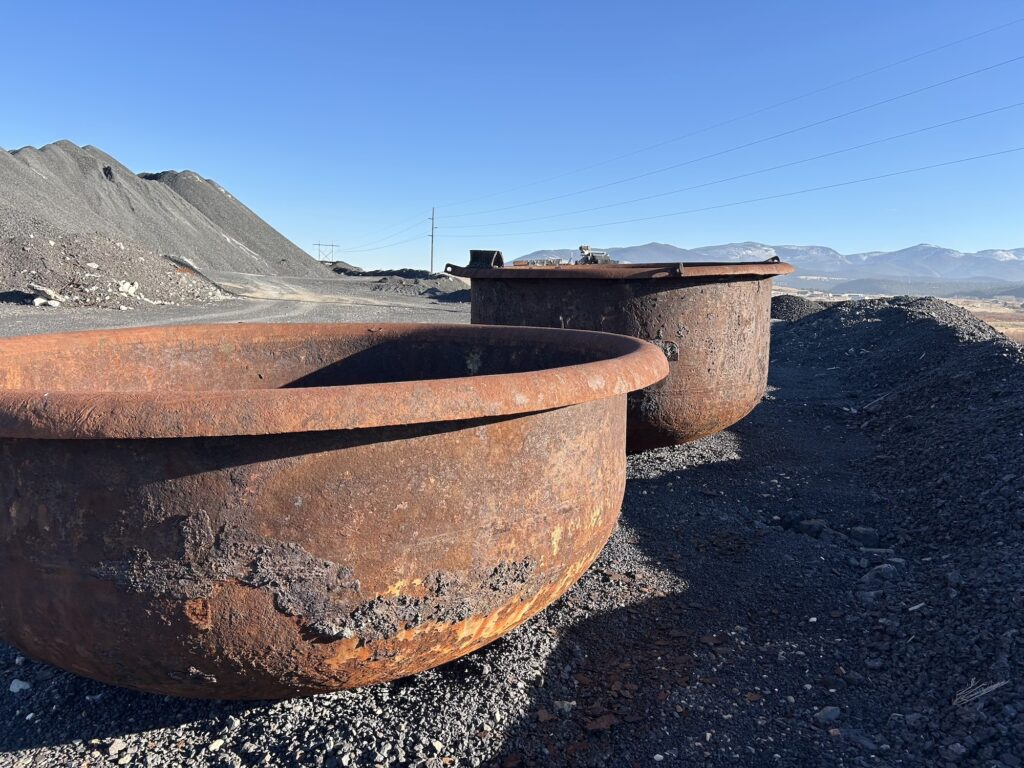
The vats that once held the molten slag, which would be dumped on the slag pile. (Piper Heath/The Monitor)
In this stage, special chemicals coat the surfaces of particles containing the target metal, making them water-repelling so they attach to air bubbles and separate from waste rock. Those coated particles rise to the top “kind of like the froth on a beer,” said Jerome Downey, department head of Metallurgical and Materials Engineering at Montana Tech.
The result is a lead concentrate that’s ready for smelting. That concentrate goes into furnaces ranging from 1,200 to 1,250 degrees Celsius, and workers add materials called fluxes to create the right chemistry for extracting pure lead from the concentrate.
Inside the furnace, everything melts and the molten materials separate by density; heavier metals sink to the bottom while lighter waste material floats on top. “You can think of it like oil and water,” Piatek said.
Workers would collect the lead bullion, or unrefined lead, that sunk to the bottom. But the remaining waste had to go somewhere. Multiple times each day, ASARCO workers would load the molten slag into massive vats and transport them to the slag pile.
“They had these big vats, and it would go up there liquid…and it would just tip and run out, pour off the sides, and then it would cool on its own,” said Mark Rhodes, the site manager for East Helena under contract with METG. “At night, you’d see the hot, molten slag running off the side of the slag pile. It would glow.”
The cooled, hardened waste is known as slag, a derivation of the word slat, meaning thin sliver. Day and night for 113 years, until the smelter shut down in 2001, workers poured out their vats of molten waste, contributing, hour by hour, to the expansion of one of the world’s largest slag piles.
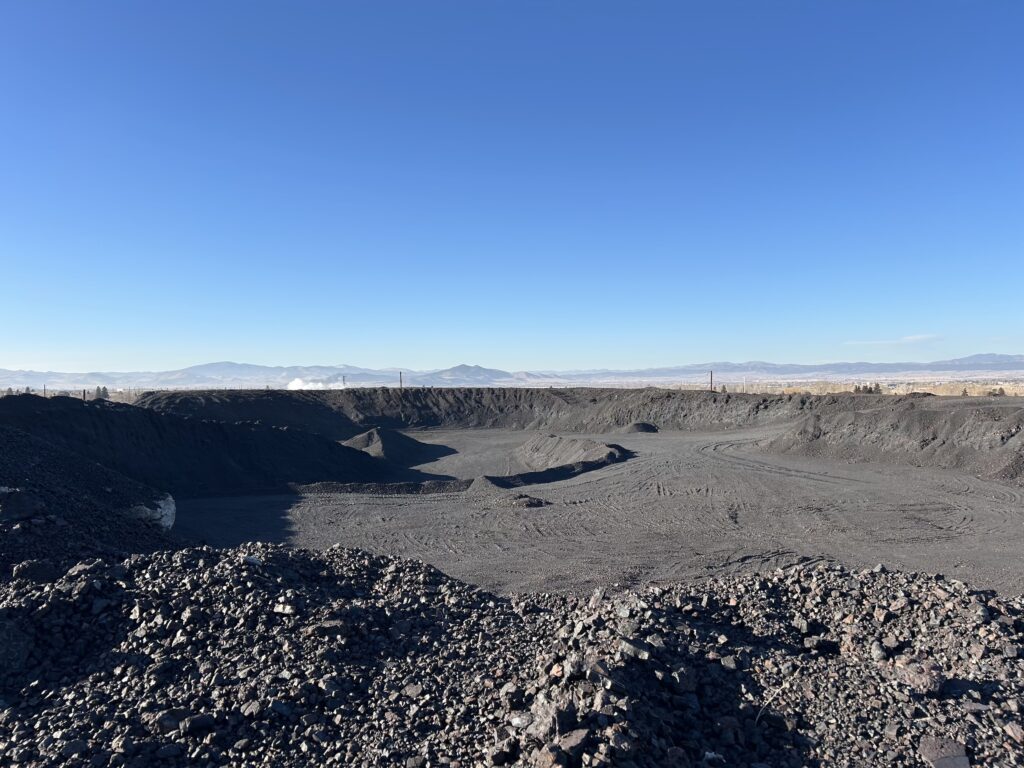
A pit of fumed slag on the pile that Ash Grove Cement draws from. (Piper Heath/The Monitor)
The slag exists today as irregular chunks ranging from gravel-sized to much larger, requiring crushing before being moved or sold. The pile contains two chemically distinct types of slag – fumed and unfumed – based on whether zinc had been extracted before the dumping of the slag. Of the total 16 million ton pile, roughly 13 million tons, or nearly 80 percent, is fumed slag.
“When you have an ore that has both lead and zinc in it, the way that you recover the ore is first you take out the lead, and then you make a lead slag,” Piatek said. “That’s the waste from that. And then you remove the zinc from that slag.”
From the smelter’s opening until around 1940, ASARCO poured unfumed, or zinc-rich, slag onto the pile. Then in the early 1940s, the company built a zinc plant on site. From that point forward, slag went through an additional step, fuming, before being dumped.
From the 1940s to 1982, the pile grew with fumed slag. But when the zinc plant shut down in 1982, the smelter returned to dumping unfumed slag for its final 19 years of operation. This created the “upper lift,” or the approximately 2 million tons of zinc-rich material sitting on top of the older fumed and unfumed slag.
While some types of slag serve environmental purposes – for example, ferrous slag from steel production can help neutralize acidic conditions and absorb excess phosphate from water – East Helena’s base metal slag from lead smelting doesn’t have those applications. But it remains valuable for metal extraction and cement production.
Indeed, the fumed slag has found a steady buyer over the years. Ash Grove Cement in Montana City has purchased some 70,000 tons over the past 15 years. The unfumed slag, with its zinc content still intact, is even more attractive to operations that can extract the metal.
That zinc attracted Metallica, a mineral asset development and trading company. In 2021, the Montana Environmental Trust Group (METG), which owns the smelter site, partnered with Metallica to ship crushed unfumed slag to the Korea Zinc smelter in South Korea. Workers crushed the slag to two inches or smaller, then shipped it by rail to Canada and over to South Korea.
Between 2021 and 2024, Metallica shipped approximately 145,000 tons of unfumed slag. But supply chain disruptions and high shipping costs made it impossible to meet the contract’s tonnage requirements. Korea Zinc terminated the deal in June 2024.
Last May, METG began working with the waste and recycling firm RED Industries to find new buyers, and the Montana Bureau of Mines and Geological Survey started testing the slag to gain a clearer understanding of its composition and value.
Beyond zinc, the tests may reveal other valuable materials. Julie Klinger, associate professor of environmental studies at the University of Wisconsin-Madison, said that because rare earth elements represent 17 elements on the periodic table, “mining, industrial, and other metallurgical waste streams are likely to have at least some trace.”
But she cautions that pursuing rare earth elements (REEs) alone is rarely economically viable; even mining companies allow significant amounts of rare earths to end up in their waste streams because the elements are not as valuable as their name suggests. Instead, economic viability would come from “recapturing many different useful and valuable materials alongside REEs,” she said. “This is a standard strategy employed by mining companies.”
While a single slag pile can’t produce enough material to compete with traditional mining operations, Klinger says the economics could change if the U.S. reprocessed many legacy waste sites as part of cleanup efforts.
Until the pile is capped or shipped away, it will remain an indelible feature of East Helena. Unlike organic waste that decomposes over time, slag never breaks down. “It doesn’t degrade naturally,” Downey said. “There may be some erosion, there may be some other things, but those things would be relatively minor.”
That permanence is precisely why the EPA has mandated a long-term solution, approving grading and capping the slag pile as the final remedy. But removing the unfumed as much slag as possible before capping would offer significant advantages, reducing the cost and timeline for the final capping project.
The challenge is finding a viable market for material that’s expensive to ship, yet exists in quantities that exceed North American processing capacity.
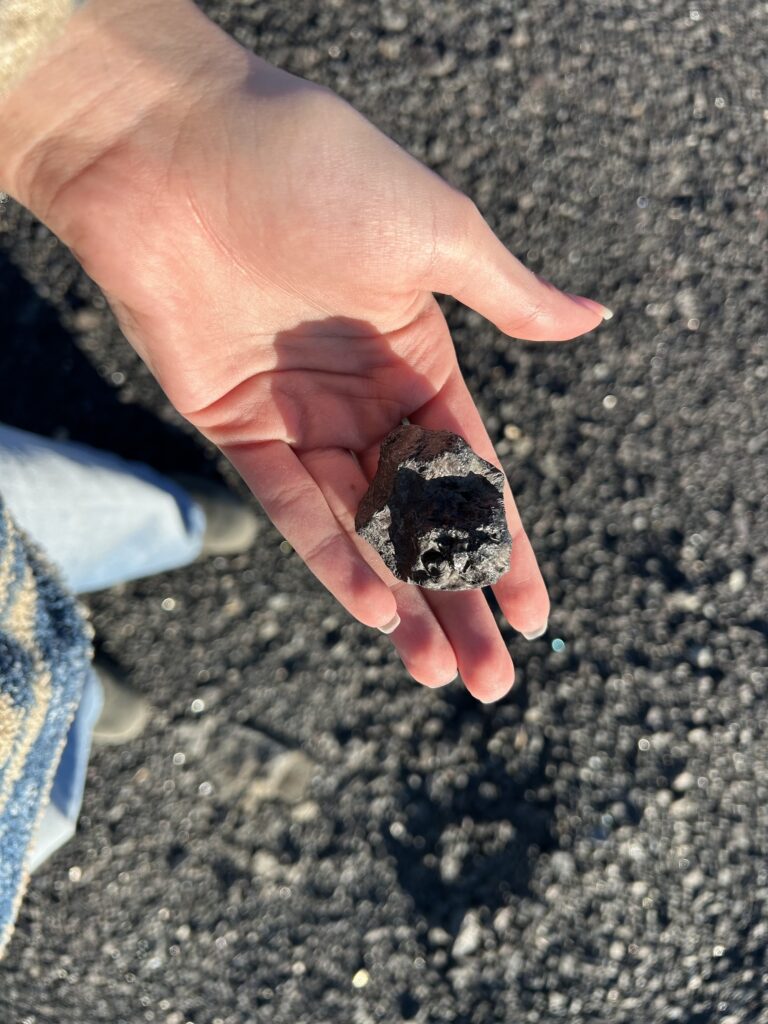
A small piece of slag from the pile, with an obsidian-like sheen. (Piper Heath/The Monitor)
Key facts, figures, and details:
- East Helena’s pile of slag weighs 16 million tons and stretches across 65 acres – roughly the size of 50 football fields.
- Standing about 150 feet tall, it’s about the height of a 15-story building, making it the highest man-made structure in greater Helena.
- The former smelter site spans roughly 140 acres, with the slag pile covering 65 acres.
- An evapotranspiration cover system over 60 acres of the former smelter processing area, constructed between 2013 and 2017, uses vegetation and soil layers to prevent water from seeping through contaminated areas and carrying pollutants into groundwater.
- Two Corrective Action Management Units (CAMUs) – hazardous waste landfills – store contaminated demolition debris from the site.
- Next to the pile is something unexpected: a lovely 240-acre park with rolling hills and creek access. Hat tip to the Prickly Pear Trust, which opened the park last year.
- In 1984, the EPA named East Helena a Superfund cleanup site, filled with potentially harmful chemicals due to smelter operations.
- The Montana Environmental Trust Group became the custodial trustee of the site in 2009 following ASARCO’s bankruptcy settlement, and oversees the site’s cleanup.
- In August 2009, the ASARCO smokestacks were felled by dynamite, an emotional local moment that left the slag pile as the dominant sight on the landscape.
- Nonferrous slag from base metal smelting operations like East Helena’s is composed primarily of iron, silica, aluminum and calcium, though it typically contains various trace metals.
- Hoary marmots have colonized East Helena’s slag pile, making homes in crevices between chunks of slag. Site workers regularly see them running across the pile in summer before they hibernate in late August.