
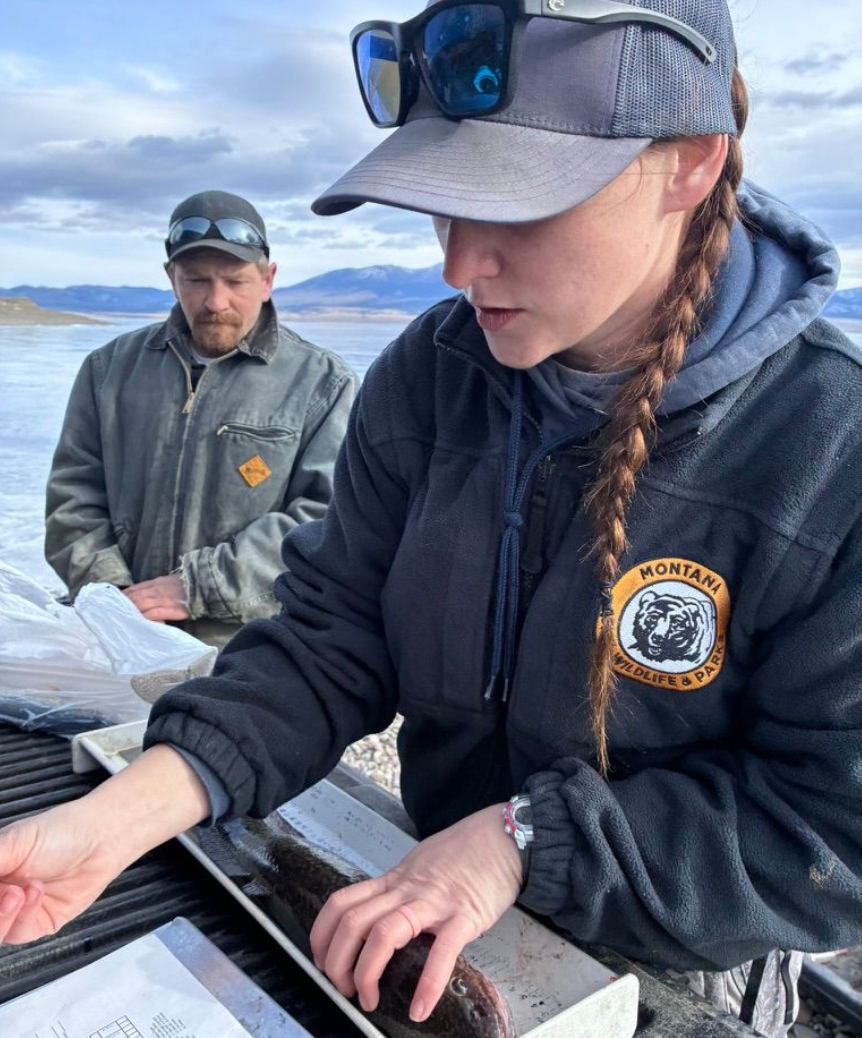
On a recent, brisk Sunday morning, Ashton Mohar stands on a boat ramp on the southwest shore of Canyon Ferry Lake, clipboard in hand, cheerfully waiting to ask ice anglers to let her appraise their catch for Montana Fish Wildlife and Park’s (FWP) only year-round fishing survey.
A sharp wind blows off the lake, making the relatively temperate day feel chillier. Yet Mohar keeps talking a mile a minute, undeterred. Perhaps it’s no surprise, as the 31-year-old FWP fisheries technician, a.k.a. creel clerk, is out surveying nearly every weekend.
She makes her way down to the banks where a trio of fishermen are packing up for the day. She greets the man closest to her with some familiarity, letting her voice go higher as she encourages him to calm his barking dog.
“How’s it going?” she calls out.
“Slow,” says an angler setting down a hefty-looking plastic bag that seems to be moving.
They chat about ice thickness (about seven inches) as she digs into the bag, which holds one small walleye, a trout, and a burbot. The angler, Mark Herrin, lives in Lewis & Clark County and had come looking for walleye. He’d been fishing the Missouri since he was a kid, coming out with his grandfather on weekends. He’d normally be on Lake Holder, but the almost non-existent ice there had forced him over to Canyon Ferry.
“These things are my favorite fishes in the whole entire state of Montana,” Mohar gushes about burbot as she puts the fish on her measuring board. “They’re native species, and they’re very primitive…in geological records and fossil records, they haven’t changed. And they’re the only member of their family that are freshwater. The rest of them are all saltwater… These guys just got trapped inland after glaciers receded.”
She turns to tell Herrin about the impressive burbot she’d weighed the day before, nearly three and a half pounds. “There’s so much burbot this year,” she says, picking up the next fish.
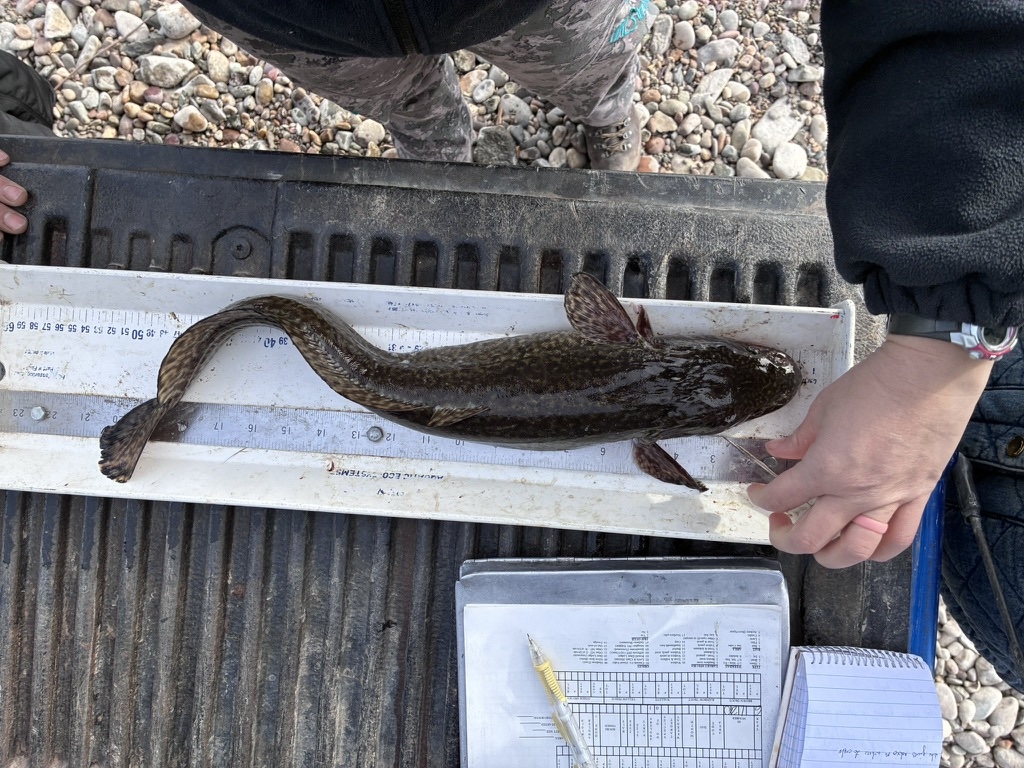
This, essentially, is the process of a creel survey, named after the traditional wicker fishing basket. A FWP agent, known as a creel clerk, queries that day’s anglers about just about everything: the duration of their outing, where they caught fish, the bait they used, and the depth, plus the species, their length and weight and even their fishing habits.
It’s all invaluable FWP biological data that shapes management plans. They study anglers’ daily creels, for instance, to decide which fish might need to be replenished, and where. The Upper Missouri River Basin, which includes Canyon Ferry, Lake Hauser, Lake Holter, and Lake Helena, has a separate management plan from the rest of the state due to its unique ecosystem.
For one thing, it’s a “blue ribbon ecosystem”, which means it offers exceptional angling and fish habitat. Mohar views it as a slightly antiquated term that nevertheless communicates the basin’s quality. When the first big dams were built at Hauser and Holter in the early 20th century, decades of human activity had already interfered with the natural rhythms of this stretch of the Missouri. “It was just always kind of managed separately from traditional rivers and stuff in other places of the state,” Mohar says.
FWP began creel surveys in the Missouri Basin in the 1980s, making it one of the longest continuous surveys in the state. The surveys also provide the foundation for FWP’s weekly fishing reports, published every Monday.
It’s a sort of crowd-sourced fishing: by regularly sharing catch info with FWP, anglers learn which fish are biting where, what type of bait is working best, and so on.
“The fishing report is something that we put out as a ‘you rub my elbow, I rub your elbow’ – because we want the biological data from the anglers,” Mohar says.
Wrapping Herrin’s final fish, she advises him on where the ice is safest to cross on Duck Creek, where he might have better walleye luck. In the middle of a warm, dry winter, the ice on Canyon Ferry Lake is quite thin – just seven to eight inches, according to anglers.
This is the least amount of ice Mohar has seen in her six seasons as a Fisheries Technician. Normally by mid-February the ice is at least 10 or more inches across most of the reservoir. The thin ice is a safety concern that also undermines data collection.
When she’s able to drive her side-by-side on the ice (at least 10 inches), Mohar can do up to 80 interviews a day. The thin ice forces her to drive around the lake and she ends up chatting with maybe 20 anglers. It’s also probably why burbot have been so plentiful this year, as their breeding cycle occurs under warming ice as spring approaches.
Looking out over Canyon Ferry, thick sheets of white ice bulge above the water level, indicating places where pressure from water movement below forced the ice to surge and crack. At least three times during a two-hour outing, Mohar pulls out her binoculars to peer toward the mouth of the Missouri scanning for gray ice, which indicates thinning to the point of compromise.
So far, it appears the creek has yet to completely break up the ice, which would be a serious safety hazard. “I always tell people, like, just use your best judgment, and you know, always decide on the caution of safety,” Mohar says, leaving Herrin behind. “They’re just fish. Your life isn’t worth a perch.”
Mohar walks past her truck and down to the next inlet, where a bright red hut sits on the ice. Mohar puts on her ice spikes and begins her trek across, avoiding areas of open water along the shore. The Monitor was unable to accompany her due to safety concerns, but her conversation with the anglers could be heard clearly enough.
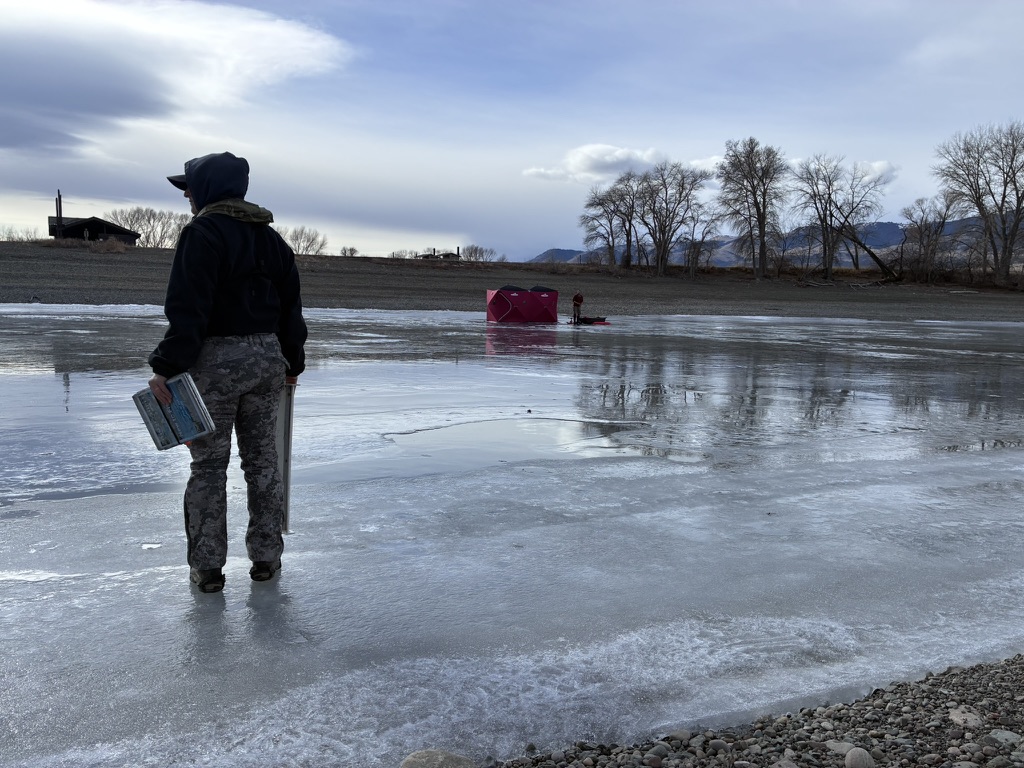
Two anglers occupying the hut are mainly after trout, hoping to smoke them later. Mohar quickly suggests a dozen sources for good trout recipes. Her approach to her work makes each data point so much more than a simple statistic. Every interaction is as much about the person as the fish.
Being so public facing and bearing the official seal of the FWP on her hat and truck come with their own challenges. Mohar must be an expert in topics ranging far beyond her paygrade, or at least know who to direct the public to.
She’d begun her day fielding a local’s complaint that the water level was too low, something FWP has no control over. That, she says, is largely the Bureau of Land Management’s purview. Still, she listens and tells him where he might find out more information.
“That’s why this position is so unique,” Mohar said. “As an agency department member, and just being a human, it’s a good thing to be out here and constantly talking to anglers and hearing what they want to say and getting their opinions.”
For some, the process might seem repetitive, even exhausting. But for Mohar, that’s the point. “It’s actually, honestly, my favorite part,” she says. “I love talking to people.”