
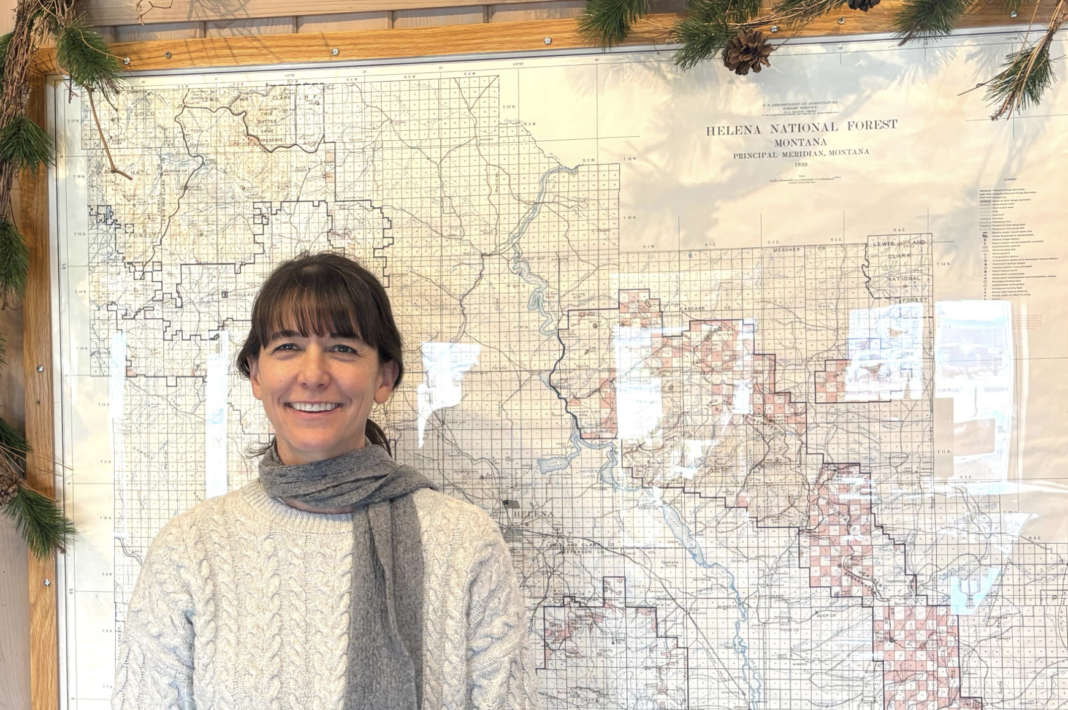
When you fall in love with trees not long after learning to walk, you may end up spending your life in, around, and thinking about the forest. That’s the case for Oregon-raised Emily Platt, who has since early 2022 served as supervisor of Helena-Lewis & Clark National Forest – the country’s 10th largest national forest.
The U.S. Forest Service veteran sat down with Monitor editor David Lepeska in early February to explain her thinking on forest management and prescribed burns, the value of a mosaic forest, the power of a walk through the woods and more.
Monitor: Where did you grow up and when did you fall for the forest?
Emily Platt: I grew up in the suburbs of Portland and we had this big empty lot next door, like a fairly large lot full of Douglas fir trees. And we’d play there all the time as kids, ride our bikes through, have pine cone fights, look for salamanders. So it’s been a part of my life ever since I was a kid. As early as I can remember, we’d play in the woods.
Monitor: OK, and that led to studying forest management. How did you start working for the Forest Service?
EP: I did my graduate degree at the College of Forestry at Oregon State University, and I did an internship with the Forest Service while I was in graduate school. And that’s when I realized the Forest Service would be a good fit. I worked in the policy office, in Washington, D.C. Kind of an odd place to start, but we were working on a project where my job was to go talk to all the departments about what they wanted to see incorporated. It was a great way to get to know all the different areas of the Forest Service, what people were thinking about, how they operated.
Monitor: I’m a huge fan of huckleberries, and it’s so frustrating that you cannot find them fresh because there’s no commercial harvests. But I saw that you worked on a huckleberry harvest years ago. Please tell us about that.
EP: When I was doing huckleberry work I was in the [Pacific] Northwest and there are far more huckleberries there. And actually, in that district, we did have a commercial huckleberry harvest on National Forest land because we had so many huckleberries. And you could totally buy them fresh, which is fabulous.
Monitor: You were named to this post four years ago this month. What have you learned in these four years about how people use Helena Lewis and Clark National Forest?
EP: I came from a much more populated area, so I think one of the things that has been most noteworthy to me is just the unbelievable solitude you can enjoy when you’re out here on public lands in this area. It’s a really different feel and pretty spectacular.
Monitor: Please walk us through the average day in the life of a National Forest Supervisor. People might imagine you walking through the woods all day, but I’m guessing that’s not what you do.
EP: If you find that job, I want it. But yes, one of the things I love about this position is that it’s super varied. It’s different every week, every day. Last week I spent half a day working with the state DNRC on a joint plan for our Good Neighbor Authority projects. I spent an afternoon talking with some of our litigants about a project they’re worried about. I met with our fire staff who were preparing for the upcoming fire season. We have some consultation and design features to work out with some of our projects so that Fish and Wildlife can accept them and give us a biological opinion.
Monitor: So when are you walking through the forest?
EP: It doesn’t happen as regularly as I’d like, but we do get out there to look at projects. Honestly, sometimes the best way to move something forward is to go out into the field. A field tour can help people look at something in a different way. It makes it a little more real and less philosophical.
Monitor: HLCNF is 3 million acres. You’ve probably seen most of it. What are your favorite places?
EP: I can’t tell you my favorite places because they’re really quiet. But I will tell you my favorite area around Helena. The Ridge Trail is a beautiful, wonderful trail that people should check out if they haven’t seen it. It’s awesome and easy to get to right here in town.
Monitor: I often hike around Helena, including in National Forest land, and I noticed after last summer’s thinning, the forest looks borderline sparse. I’m all for protecting homes, but I wonder if there’s a trade-off between increasing safety and having denser, more vibrant forests?
EP: Areas really do look different after we manage them. They look really open. And that openness is more aligned with historically how forest would be in, say, a low-elevation ponderosa pine forest. People have gotten used to these denser forests, but that’s not necessarily what we had in the past. It was a bit more patchy: you’d have open patches next to dense forest patches. Having that mosaic of open forest with denser forest creates a sort of insurance policy for your forest so that it really dampens fire behavior and helps you get more low severity fire and mixed severity fire rather than high severity fire. The other thing about really open areas is they are particularly fabulous around homes and where we have built infrastructure, because it definitively changes how fires behave. It gives us more management options when wildfires come and makes it way more likely we’ll be able to protect homes and people’s lives.
Monitor: HLCNF’s new prescribed fire project aims to burn 40,000 acres annually for the next 20 years, tripling the previous total. But in a 2013 speech of yours I saw online, you talked about how the Deschutes National Forest wanted to reduce fire risk but could only work in five-acre parcels, which sounded crazy. Please talk about that and how such plans have since changed.
EP: Right, and that was in the management plan. It’s totally crazy. But yeah our new forest plans are really so much better than the old ones because one of the things they try to do is focus on the outcomes we’re trying to achieve rather than these incredibly prescriptive measures about how to do any particular thing. And it tends to look at things in a landscape-scale rather than a five-acre parcel scale, which makes it easier to achieve those landscape objectives. For us, changing how wildfires burn across this landscape, it’s much easier to do with a modern forest plan compared to the forest plans we’ve had historically.
Monitor: You say it’s based on outcomes. Do you sometimes not get the expected outcome?
EP: The stuff we do is not rocket science, to tell you the truth. In our forest plan we have desired conditions based on what we know about certain forests. We have a lot of dry, ponderosa pine forest and some dry mixed conifer forest, and for those kinds of forests we know the distribution of size classes, for instance. And if we know we don’t have as many large trees as we like, we grow more large trees. We know that over time, the species composition has shifted, and we have more Douglas fir now than in the past, so we’re going to reduce that. Supporting whitebark pine populations, you know what I mean? Things like that.
Monitor: About the Prescribed Fire Project for HLCNF, do you have an expectation in terms of fire reduction in the area in the coming years? For instance, 20 percent fewer fires in the area?
EP: Our expectation is not that we have fewer fires, but that it changes the kind of fire we have so we have less high severity fire. That is definitely an expectation, and that is absolutely aligned with the science. I think we can anticipate that. We’ve been doing fuels reduction in the Helena wildland-urban interface for quite a long time, and we’ll keep doing that work. [But] this really allows us to have an impact at a greater scale. We won’t be able to have an effect across 3 million acres, but we will be able to have an effect potentially at the scale of the Elkhorns, which is one of our geographic areas.
Monitor: Returning to the idea of the sparser forest, one goal of the prescribed fire project is maintaining more live forest while improving wildlife habitat. To me, as a forest neophyte, that seems contradictory. Doesn’t fewer trees mean more exposed earth, which results in less shrubbery and ground cover, which means less food for the small animals the predators feed on, and thus less wildlife and a less active forest?
EP: That’s a great question. And it’s a temporal thing and a habitat thing. We’re treating roughly 17% of the landscape over the life of this project, and that means a bunch of areas will be unmanaged. So what we’re managing for is really a mosaic of conditions. We’re not managing for those open conditions everywhere. We’re managing for those open conditions next to forest cover positions. We’re managing for a really patchy mosaic of habitat types. And when you have more of a diversity of habitat types, you support more of a diversity of wildlife species, because some species do rely on those open conditions.
And it’s like an insurance policy for your landscape because those openings help dampen fire behavior. So you get less high severity fire, and that helps you hang on to your live forest over time, rather than just in this instant. Because if we tried to hold on to 100% of the forest we have now and into the future in this frequent disturbance environment, with wildfires and drought and insect mortality, the landscape can’t do it. It’s untenable.
Monitor: Another thing you mentioned in that 2013 speech was how Forest Service managers told you it took them four to six years from project idea to implementation, which sounded like a long time. I wonder if that’s still the case today to some extent, or has it changed?
EP: In the Forest Service we are always looking for ways to do things more simply, more quickly. And that’s one of the reasons we did the forest-wide prescribed fire project. I calculated the number of years we saved in planning time, it’s 70 years. Doing that one decision across the whole landscape for something we know is needed saved us 70 years, because we would usually chunk it out. And that was a conservative estimate that assumed people never left, we never got new species listed, and nothing ever went wrong. So yes I think things have gotten better because we’ve been able to create space for people to be a bit more innovative about focusing on getting the right work done on the ground.
Monitor: When we reported on the new prescribed burn plan last summer, you had completed an environmental assessment and were talking about launching the project soon in the Elkhorns. What’s the status with that? Is it starting soon?
EP: Yes, we are. I get to sign the decision very soon and we plan to implement this spring. And the Elkhorns will likely be the first place we implement.
Monitor: And how much would you expect to burn in the Elkhorns this year?
EP: That really depends on weather conditions, so it’s hard to say. It could be up to 3,000 acres. We have definitely looked at specific areas that we’d like to go to first. But the locations have not been decided.
Monitor: This winter’s been warm and dry. How much does that affect your work? Does it concern you?
EP: Water issues certainly have an impact on us. Drought conditions, for instance, will make trees more prone to insect mortality, more susceptible to some kind of disturbance. Also, it directly affects the fire seasons we have. The dryness is definitely one factor that affects how quickly fires burn, how quickly they spread.
Monitor: If it does stay quite dry for the next few months, would you take some precautions to reduce potential wildfires?
EP: We have limited options at that point. I mean, you still need an ignition event. So we try to make sure people are being safe and careful out there. If we need to, we could do fire restrictions. But we try to only do that when it’s necessary because we like people to be able to have campfires.
Monitor: What advice would you give to our readers who go hiking, fishing, hunting in the forest, about how to do it wisely and respectfully?
EP: National forest lands are unique in the world. They’re really such a cool thing. So first and foremost, people should just enjoy them and appreciate that we have them and get to access them. One other thing, we do have grizzly bears coming through the area and the more careful people are with food storage, that will keep them safe and will keep the bears safe.
Monitor: Lastly, I noticed that every time I drive into the National Forest, the road quickly goes from good to terrible. I’ve asked locals about this and a few told me it’s intentional, that the Forest Service aims to minimize the number of visitors and reduce upkeep. Is that true?
EP: We’d love to be able to manage our roads to provide more access. But no, we are not intentionally managing for roads that are difficult to drive on. We wouldn’t do that. Besides, it wouldn’t work. Bad roads do not stop people from visiting the woods because the woods are great to visit and people are going there for a reason. A bad road does not stop people.