


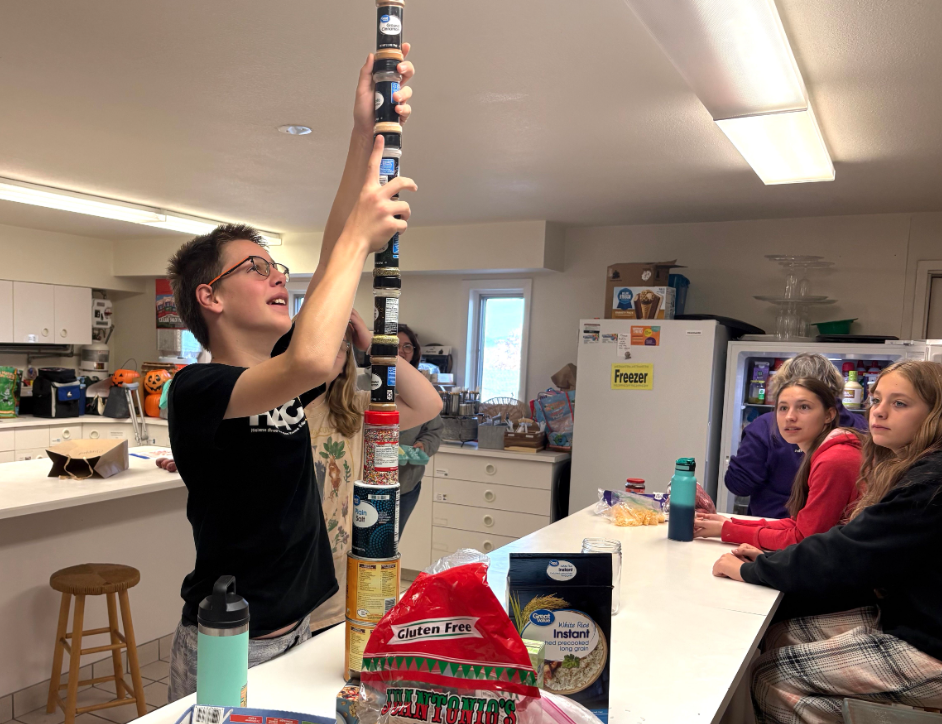


Nels stacks spice canisters as the judges look on. He did not receive extra points (David Lepeska/The Monitor).
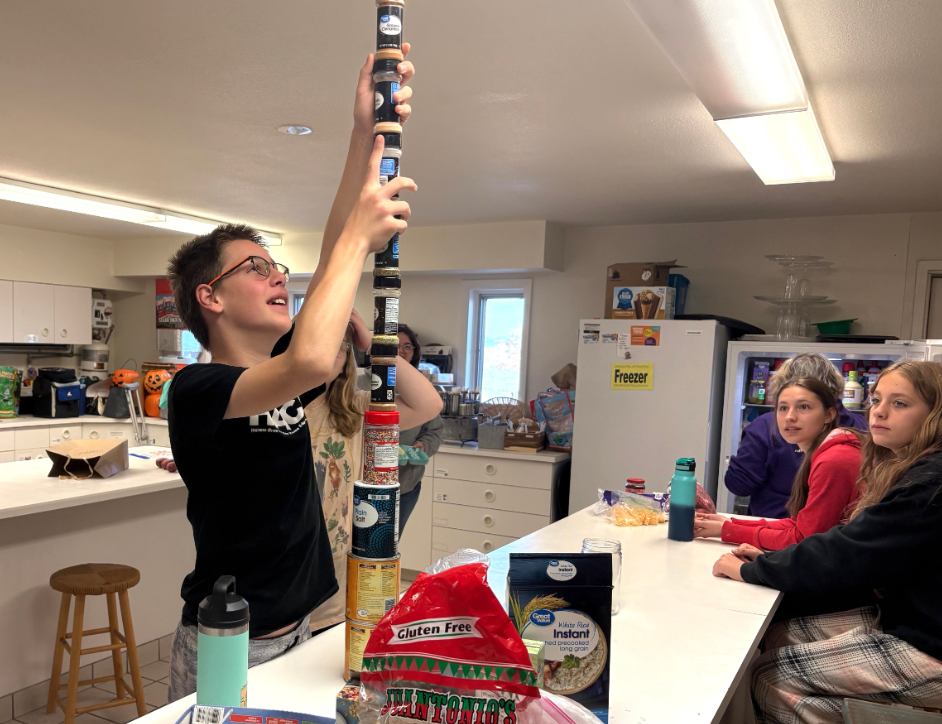
Crowding around the Chopped class stove. Annie, Josie, Melody and others jostle for space as the clock ticks down (David Lepeska/The Monitor).
The pork fillets, red potatoes, apples, and cranberry sauce sit ready and waiting. “Today we’re making breakfast and here’s what you have to cook with,” Phronsie Howell announces to a dozen teens inside a basement kitchen on a recent morning. “Now go!”
Three trios of young chefs huddle to devise plans in this homemade edition of Chopped, the reality show where contestants create a dish from surprise ingredients. Aged 12-18, the students have up to 40 minutes to craft something delicious for their peers, who score them on creativity, taste, and presentation.
“They make whatever they think of, whatever they want,” says Howell, who dreamed up the class earlier this year. Winners are exempt from clean-up and get to choose the ingredients for, and judge, next week’s competition. Past classes have cooked macaroni and bacon, and curiously, pickles and wheat.
East Helena’s Cecilia Ries, 16, plans to spice her meat with paprika, onion powder, and garlic before sauteeing. Her teammate, Melody, the class tinkerer, is thinking bigger.
“I’m making a sweet pan bread with cranberry sauce apple jam – it’ll be kind of like naan,” she explains. Not all Melody’s experiments succeed, she admits: “I’ve started, like, three fires.”
Team Two is thinking mashed potatoes and applesauce, while 15-year-old Annie takes the lead for Team Three, envisioning scrambled eggs with cubed potatoes topped with pork strips. “We have it all the time,” she says. “It’s a nice breakfast.”
Her teammate Nels, 15, is stacking spice canisters on the counter. Howell watches silently, letting the teen enjoy his impromptu structural engineering challenge. The would-be chefs slice, dice, shake, and drizzle as Nels’ tower stretches precariously toward the ceiling.
“Something’s burning!” somebody shouts.
Scenes like this play out every Friday at the Helena Homeschool Enrichment Co-op, where some 200 kids and parents transform a warren of nine basement classrooms into little worlds of discovery, from math and science to singing, drawing, physical education and more.
“It’s controlled chaos,” co-founder Chris Hauer says of the growing gathering at Helena Alliance Church, which seeks to build community around faith, friendship, and educational flexibility. New challenges always emerge, she adds, but “we’ve gotten a lot of stuff worked out and it’s mostly pretty streamlined now.”
The idea for the co-op emerged in 2011. Beth Ries, a longtime Eastgate resident and mother of four, recalls talking to Hauer, who also lives in the East Helena school district, about starting a co-op after the one she’d been a part of disbanded.
They reached out to a co-op at Bozeman’s Grace Baptist Church, which sent them its handbook. That helped establish a framework and guiding principles. But Ries is Catholic, while Hauer is Protestant, so they cut a lot of Grace Baptist’s rules to make for a more open compromise.
“I’d say the co-op is generically Christian,” says Ries. Each Friday opens with the Lord’s Prayer, but families of all faiths — or none — are welcome. The focus is on valuable learning opportunities for kids and building relationships for all. Attendance doubled each of its first few years, then saw another bump after the pandemic. This reflects broader trends. Homeschooling has doubled nationally this century and increased 28% in Lewis & Clark County since 2020.
Kids at the co-op range from age 0 to 18 and are divided by age, resulting in seven groups from infants through 12 to 18-year-olds. The nursery is the only room without instruction. For other under-12s, classes cover physical education, STEM, performance, art, and public speaking.
The mainly teen group is able to devise, suggest, and vote on their own courses, which must meet two of three criteria: be educational, promote student interaction, and be fun. Recent classes include archeology, photography, stop animation, survival skills, and cake decorating.
“The teens love it because there are always classes they want to do,” says Howell, who lives in East Helena near Radley Elementary and has three kids.
The co-op runs from 9:30 a.m. to 1 p.m. and parents stay on-site, typically teaching or assisting one class, observing another, and socializing during a third. Several moms said they relished the opportunity to teach other kids and appreciated their kids being taught by other parents, expanding their knowledge base.
Price is another draw at just $5 per child per semester. “We decided to be the place that, no matter what your financial situation, you can come,” says Hauer, adding that the fee covers maintenance and occasional supplies.
The church charges no rent, but does require $500 for annual insurance, which the co-op covers with a spring bake sale. Given that other Helena area homeschool co-ops charge hundreds of dollars per semester, it’s easy to understand Enrichment’s popularity.
Soon after reaching its max capacity of 110 students and starting a waiting list, the co-op was profiled in an August article by the libertarian think tank, the CATO Institute. The national attention has changed little on the ground. At any given time, nine rooms present varying levels of kid activity and learning, including three course options for the 12-18 group.
As the Chopped chefs leverage their culinary skills, for instance, The Monitor strolls over to the nearby job skills class. “Colton is a cuber, he’s even put on a Rubik’s Cube contest in East Helena,” Ries, the teacher, says of Colton Hulin. “Tell us about your YouTube channel.”
Colton sits up in his chair. “I’ve done some tutorials,” he says. “But I mostly post videos of my Rubik’s Cube stuff.”
Ries finds his channel on her phone and shares a video with the class. In it, Colton begins turning an eight-sided, diamond-shaped device. “This whole video is me solving this octahedron,” he explains.
Ries turns to the class’s designated hiring manager, 12-year-old Zeke, and asks whether this YouTube channel would boost Colton’s chances of getting hired. “If I was hiring someone for engineering, I can’t solve a basic Rubik’s Cube, so if he can solve that thing, he’s got the job,” he says.
Emily Warhank, an insurance agent and the class’ guest speaker that morning, points out another reason. “You’re very tenacious, which is important,” she says to Hulin. “The reason a lot of people don’t do Rubik’s Cube is because it’s really difficult. But you did not quit. You kept going. Most people give up pretty quickly.”
Thinking about his future career prompts Colton to reflect on his six years at the co-op, where he’s made a lot of friends. “Next semester is my last semester. I’ll be sad,” the 17-year-old says after class. What’s next? “I’m probably just going to work for a year, then maybe go to college. I’m still making a plan.”
Back in the Chopped kitchen, the judges, April, Karilynn, and Colton’s 13-year-old sister Olivia, are readying their palates. They agree that Annie’s team is the favorite. “She loves to make potatoes,” says April.
Since her team won the previous week with a nice-looking pumpkin pie, Olivia underscores the importance of presentation. “They get more points for that,” she says.
Melody hopes to score big points with her bread. After kneading the dough and separating it into three hunks (teams must make three plates of their dishes, one for each judge), she uses her fingers to create little pockets in each, like a pita, before tossing them into a pan with oil.
“I’m gonna see if I can caramelize the apples with the cranberry sauce in a pan, then put it inside there,” she says. Nearby, Cecilia puts the pork on the hot stove. “Can you make sure the meat doesn’t burn?” she asks her teammate Leighanna, who’s sauteeing the potatoes.
Crowding around the stove is a regular issue. “Occasionally I’ll add more time, like I did today because they’re cooking meat,” says Howell. “They learn to take turns. They basically have to.”
With up to 110 kids on some days, the coop does occasionally feel overcrowded. With just one kitchen, the co-op can offer only one Chopped class per semester, which means some of the 45 teen students wait a full year to take part.
Hauer has urged parents to branch off and launch their own co-op (“It’s not a competition,” she says) and also expressed a desire to split the Enrichment co-op students into Monday and Friday gatherings, rather than just the latter. “Chris tries to keep it from getting too big,” says Howell. “She doesn’t want to cut people out, but we’re outgrowing the space.”
Five minutes left! Howell warns the chefs, spurring increased noise and activity. Nels, the spice stacker, admits that he never cooks at home, yet he did contribute by slicing the pork into strips. Now his teammate Annie delicately places those strips atop the potato-filled scrambled eggs.
The third team’s potatoes are less than fully mashed, but with a heavy dose of cheese, that might be fine. “They’re actually really good,” says Amity. “It’s creamy and it’s chunky.”
The sliced apples failed to caramelize, but Leighanna and Melody are carefully shoveling their apple-filled cranberry sauce into the pan bread. They plate their cran-apple pockets beside the pork and the room falls silent as the judges dig in. Chefs and passersby crowd the counter.
“I’m being a judge, back off!” Olivia warns her brother after he arrives from the now-completed job skills class. The tastings begin and the judges offer comments.
“That one’s OK, but this is great,” says one.
“It’s a little salty, but it’s good,” adds another.
“This looks weird,” says a third, taking a bite. “I like it.”
Doubt creeps in among the chefs. Cecilia is unhappy with her pork chops because she’d finished cooking them some 15 minutes before judging began and they’d grown cold. Leighanna points out that Melody has never won the Chopped class. “I won like every week last year!” Melody retorts. “Right – last year,” her teammate responds.
The voices reach a fever pitch as the judges confer. A minute ticks passed, and another, as the chefs anxiously swap cooking tales. The judges review their scores. It’s neck and neck. Finally, by a single point, Melody, Cecilia, and Leighanna are declared the victors.
“This sauce is so good,” says Karlynn, referring to the apple-cranberry bread filling.
As the winners celebrate with high-fives, the judges explain their scoring choices. Remarkably, none of the students that failed to win complain about the results. Some listen to the judges’ critiques – “This was too salty;” “It just didn’t have any flavor” – while others start cleaning up.
This intense cooking competition had its stumbles and needling, but zero drama. The young chefs surmounted one hurdle after another, collaborated like longtime colleagues, supported and sought to understand each other and listened to constructive criticism. They also learned.
“It’s a really fun way to integrate home economics,” Ries says of Chopped. “I know one family, it taught them new ways to make rice and introduced new foods they wouldn’t have bought.”
Traditionally, home economics has focused on cooking and domestic skills. But what if it could be more about encouraging familial relationships? Howell’s eldest daughter met her best friend at the co-op and they hang out all the time on their own. Hauer has seen again and again how putting various grade levels together leads to strong social bonds across age-groups.
“You might help somebody who’s two or four years younger and going through something you went through before,” she says. “They just naturally build up these family-like relationships.”
In the lead-up to Thanksgiving, that feels right — a group of teens around the stove, learning to create, cooperate, and connect.