
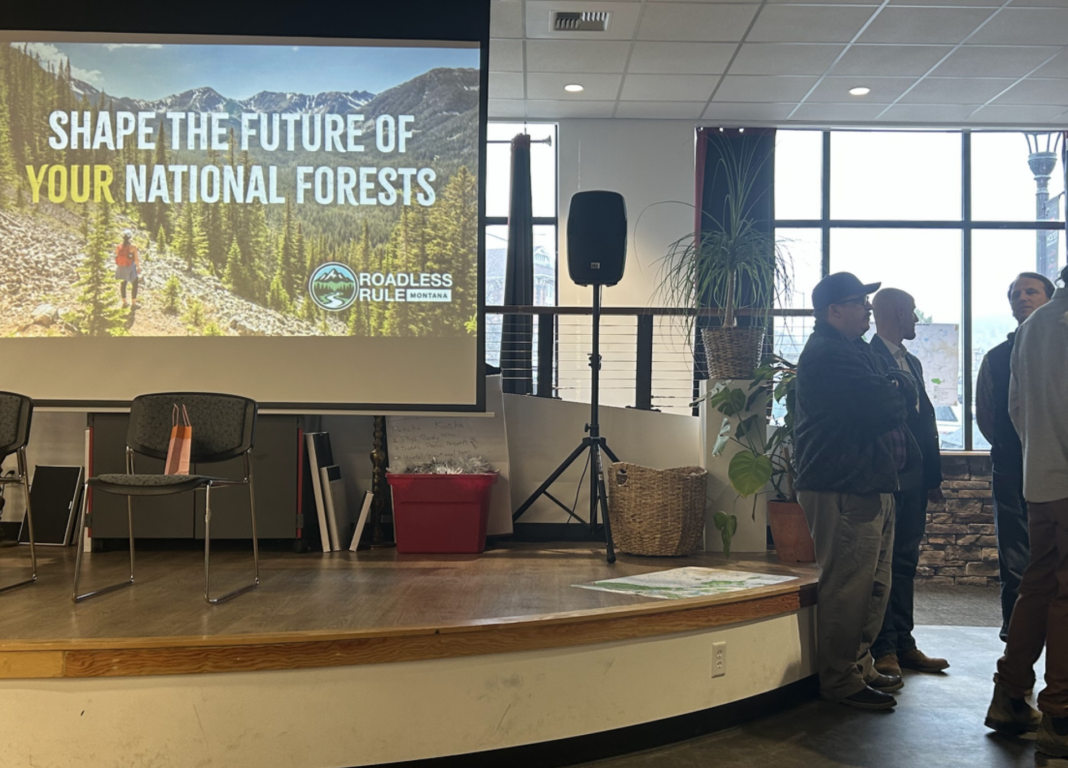
An energized crowd filled an auditorium at Helena’s Holter Museum Friday to discuss a federal proposal to rescind the Roadless Rule, which protects 1.39 million acres of Helena-Lewis & Clark National Forest – and more than four times that amount across the state.
“I live in the middle of this beautiful country, and part of what makes it wonderful is the roadless, wild nature of it,” said Hank Hudson, a Montana City resident who was among Friday’s approximately 75 attendees. “Right now it’s an important time where decisions are being made about how much roadless land we’ll have, and I think we need every bit that we have.”
Approved in 2001, the Roadless Rule seeks to establish inventoried roadless areas that bar road building and timber harvesting. Over the course of the rule’s drafting, the Forest Service held more than 600 public meetings nationwide, including 34 in Montana.
Today the rule covers 30% of all U.S. Forest Service land, or 60 million acres, and 37% of USFS land in Montana, or 6.4 million acres. In June, the U.S. Department of Agriculture, which oversees the Forest Service, announced plans to rescind the rule, with Agriculture Secretary Brooke Rollins asserting that the change would reduce wildfire risk, remove burdensome regulations and ensure productive forests.
With a final decision expected in late 2026, the Forest Service has failed to schedule a single public meeting to discuss the proposed rescission – despite 99% of the 625,000 public comments submitted last fall opposing the move.
The Montana Public Lands Defense Coalition, made up of Wild Montana, Backcountry Hunters and Anglers, Trout Unlimited and other advocacy groups, stepped in to fill the gap, organizing seven public meetings in Montana, with the last held at Holter. Just under 1,000 Montanans attended across all seven meetings, according to Alex Blackmer, senior communications manager for Wild Montana. [The coalition plans to submit transcripts from all seven meetings to the USFS during the comment period for its draft environmental impact statement, expected in April.]
Three panelists – Bill Avey, Ben Rigby and Jim Handcroft – detailed why they believed the rule should remain in place. Avey spent the last 10 years of his 40-year Forest Service career as HLCNF supervisor. When the rule took effect in 2001, he explained, the Forest Service’s 380,000-mile road maintenance backlog would have cost $8.4 billion to fulfill.
Today the USFS oversees just 265,000 miles of roads, according to Avey, and yet the backlog remains largely unaddressed, a problem not helped by the administration’s laying off of USFS workers last year.
Avey pushed back on the USDA claim that the rule hampers fire response. He cited USFS research showing that human-caused fires are three times more likely to start near roads than in roadless areas.
And to protect area homes in 2018, he approved a hot saw fire break through roadless areas south of Fletcher Pass. The process required two phone calls to conservation groups and approval from the regional forester. “There was no delay in fire response due to the Roadless Rule,” he said.
He said the rule could use some revisions – including delegating to district rangers, rather than regional foresters, the authority to put mechanized equipment into roadless areas for fire response – but that outright rescission is not the answer.
“In my experience, the Roadless Rule doesn’t pose an insurmountable barrier for making good land management decisions,” Avey said. “I do not believe the Roadless Rule should be repealed.”
Rigby, executive director of Montana Rural Water Systems and a Helena city commissioner, explained how roadless areas improve drinking water quality. The EPA has identified more than 3,400 towns and 60 million Americans whose drinking water is cleansed by roadless areas: for every 10% of a given area covered in forest, water treatment requires 20% fewer chemicals.
The Ten Mile watershed, which supplies much of Helena’s drinking water, is fed by snowmelt from nearby mountains that avoids roads and human development. “That snow touches nothing else besides that mountain, that watershed, before it comes to your home,” Rigby said. “It doesn’t get any more pure when it comes down that hill.”
Handcroft, a consulting forester with Forestoration and member of the Big Elk Divide Restoration Committee and the Elkhorn Working Group, pointed out that HLCNF roadless areas provide a critical wildlife linkage between Glacier and Yellowstone national parks.
He also questioned the stated rationale for revocation. The administration says the rule blocks wildfire management and timber production, but the federal purpose-and-need statement for rescission points to energy production.
“The oil and gas industry wants desperately to have access to…those areas to develop,” Handcroft said.
More than a dozen attendees spoke once the floor opened for testimony, with Nichol Phillips of Citizens for Balanced Use the lone voice in favor of rescission. Environmental protections would remain in place without the rule, she argued, pointing to the Endangered Species and Clean Water acts.
“For more than two decades, the Roadless Rule has imposed a one-size-fits-all restriction on nearly 6 million acres of national forest lands,” Phillips said, calling for its revocation. “This would allow local forests to make those decisions, which is where they should be.”
Timber forester Nick Horn asserted that building roads into most roadless areas is economically unfeasible, explaining that his industry seeks more flexibility along the wildland-urban interface, not the opening up of backcountry areas. “We don’t want to see the Roadless Rule rescinded,” he said. “We just want common sense management.”
Helena resident Kiley Voss laid out for the crowd a near future in which wildlife had gone extinct and a stroll through Yellowstone National Park – free of bears, wolves, bison, elk and birds – had become an eerily silent experience. The vision, as detailed in the 2020 novel Migrations, brought into focus for her what Montana has already lost and what could disappear with revocation.
“In these roadless areas, you can actually hear birds,” she said in an interview. “Water in a river sounds loud because there’s nothing else louder than it. That’s something we’ve lost, and not a lot of people talk about.”
Hudson, a hunter and angler who has lived in Montana City since 1985, said the roadless lands that remain represent a small fraction of what once existed, and future generations deserve a say in what happens to them.
“The next generations – our children, grandchildren, great grandchildren – have a right to make the decisions about this land,” he said. “We don’t have to be the final arbiters.”
He said the push to rescind the rule felt top-down, and that top-down decisions are rarely well received in Montana. He closed his testimony with a quote he could not attribute, but said he had written down years earlier.
“Celebrate restraint as an expression of our freedom,” Hudson read. “Celebrate the rare ability to leave a place as we found it.”