




This fast-passing winter has been much warmer than usual, and less wet, worsening the troubling conditions that have plagued southwest Montana for years. Lewis & Clark County experienced severe drought for much of 2025, and as of mid-January the region’s snowpack is below normal for this time of year, despite the tragic floods to the north.
All of which left me wondering where we might be headed, in terms of water availability, given the growing water concerns across the broader Missouri River basin. Digging into that question, I’ve discovered, mainly thanks to the insights of water analyst Robert Glennon, that as a mainly desert region with many high-population areas, the American Southwest is a generation or two ahead of Montana in terms of both water loss and potential work-arounds.
Few have been examining this country’s water concerns for as long, or as well, as Glennon, the Morris K. Udall Professor of Law and Public Policy at University of Arizona. He wrote the book Water Follies: Groundwater Pumping and the Fate of America’s Fresh Water, a quarter-century ago, but much of it has only become more urgent over time.
Glennon points out that most states’ water policies are still today based on Utah lawyer Clesson Kinney’s 1894 treatise on irrigation. With little scientific evidence, Kinney divided water sources into “known” and “unknown” channels, with the former essentially referring to surface water, whether above ground or below, and the latter representing an inexhaustible supply of groundwater.
This dichotomy created the division between surface water law, focused on prior appropriation, and groundwater rights, which merely call for “reasonable use” of waters that supposedly cannot be exhausted. “In fact, there is no sharp, meaningful distinction between surface and groundwater,” writes Glennon. “Instead, surface and groundwater form a continuum in the hydrologic cycle.” And yet 21st-century California, Arizona, Oklahoma and other states (in Montana, “reasonable use” now applies only to exempt wells), still base their water laws on Kinney’s 19th-century theory about unknown channels and their bottomless bounty.
And Glennon penned the following assertion in 2001, foreseeing decades in advance the endless headaches and resource problems a massive water rights loophole would create in southwest Montana and beyond: “Water for platted subdivisions usually comes from a central supply, which makes it quite simple to monitor water use. However, when property is split, each parcel will have its own well. Arizona law, like that of almost all states, does not regulate these wells, known as ‘exempt wells,’ because they are deemed so small as not to be worth the trouble to regulate…Most states have tens of thousands, or even hundreds of thousands, of exempt wells. Making matters worse, most domestic wells are relatively shallow and usually located near rivers, streams, or wetlands; their cumulative impact on surface flows can be substantial.”
Now, to peer into our future we turn to Arizona, which has seven times Montana’s population yet receives just 70% of its precipitation. No surprise, then, that its people have struggled with water problems for half a century.
“The richness of urban Arizona is because they abuse resources in numerous ways,” retired Montana water rights attorney Stan Bradshaw recently told the Monitor. “I can’t imagine that there isn’t a huge catastrophe coming down the road.”
Let’s start in Tucson, where regular recharge from a nearby aquifer sustained the lovely, winding Santa Cruz River for eons. From 1940 to 2000, the city’s population leapt from 36,000 to nearly 900,000, increasing groundwater use from 50,000 annual acre-feet to 330,000.
Rather than replenishing the river, the overtaxed aquifer began stealing from it. “What ultimately killed the Santa Cruz River was groundwater pumping,” writes Glennon. “As the population grew, the city, the mines and the farmers collectively began to pump groundwater in an unsustainable fashion.”
The water table fell 200 feet, with significant land subsidence and damage to building foundations. By 1990 the Santa Cruz was a dry sandbed. “The cottonwood and willow trees that once lined the river have died, as have the stands of mesquite, poplar, and oak,” writes Glennon, presenting photo evidence. “The birds and wildlife have gone away. The river has died.”
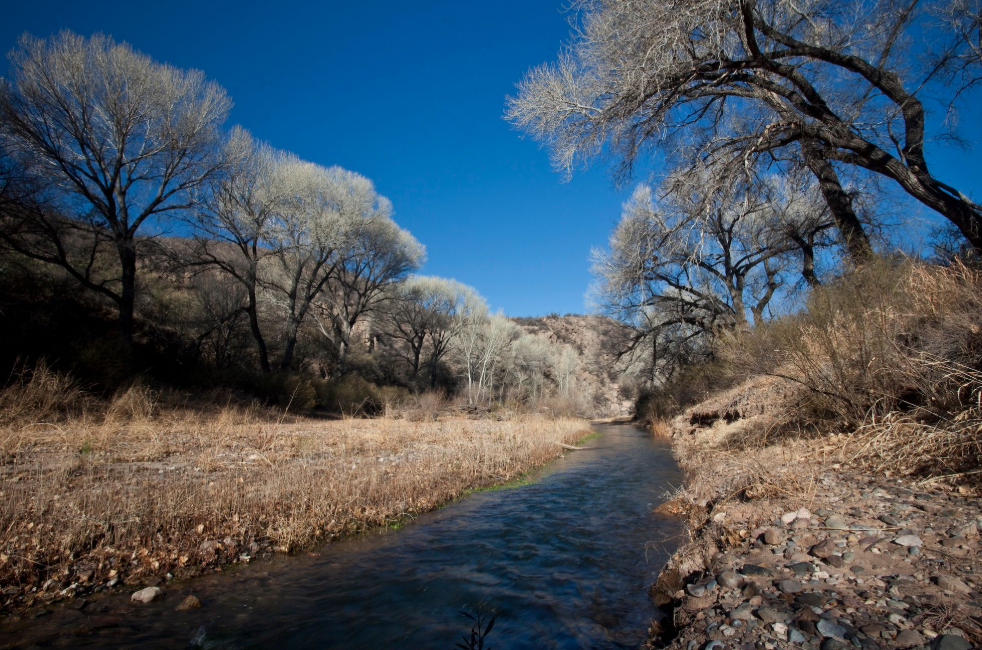
Another Arizona misadventure offers even more echoes of Montana. Just as observers were noticing the decline of the Santa Cruz, others saw troubling trends in the San Pedro River, a more popular and prominent waterway in southeast Arizona. A 1988 study by University of Arizona’s Thomas Maddock III found that nearly 40% of the groundwater pumped in the area had been capture, or water that would have discharged to the river.
The message: what had befallen the Santa Cruz had zeroed in on the San Pedro. To its credit, Congress responded quickly, turning 56,000 acres of river habitat and wetlands along the U.S. border with Mexico into the country’s first riparian conservation area. The move mostly ended cattle grazing in the San Pedro National Riparian Conservation Area, while empowering activists to challenge increased groundwater pumping.
All seemed well. Yet as in the rest of Arizona, the population of surrounding Cochise County, including the town of Sierra Vista and the U.S. military base at Fort Huachaca, continued to grow.
Things came to a head in 1999: the environmental nonprofit American Rivers named the San Pedro one of the U.S. 10 most endangered rivers; University of Arizona hydrologist Robert MacNish said the San Pedro would die due to county officials burying their heads in the sand; Interior Secretary Bruce Babbitt visited the San Pedro riparian area, declared the state had “abdicated its responsibility,” described the ongoing agricultural expansion as “an unimaginable abuse of this resource” and threatened to take river management away from local and state officials if they failed to curb growth; and finally, a report by the Commission for Environmental Cooperation, part of NAFTA, found that groundwater pumping, including agricultural use near the river, had cut groundwater discharge to the river by 70%.
Seeming to prove MacNish correct, Arizona lawmakers argued, in a statement released before the CEC published its findings, that: “The CEC study and report represent an unnecessary intrusion of an international environmental entity into state matters.”
Before I detail how this has since played out, let’s review the Montana echoes. Start with outsiders descending en masse. In the 1980s, 90s, and 2000s, Arizona became the go-to second home spot for “snowbirds,” mostly Midwesterners who liked to winter in the desert sun. These part-time residents drove up home prices and crowd locals’ beloved restaurants, resorts, and hiking trails while using up precious water resources.
As in Arizona 20 years ago, Montana today faces massive housing demand, accelerated by out-of-staters who since “Yellowstone” and the pandemic have discovered the state’s many treasures. New construction must be mindful of our limited resources – or risk destroying those very treasures.
Next, exempt well troubles. As Glennon details in the book, a local developer had planned a 90-lot subdivision next to the San Pedro conservation area. After he was sent to prison for fraud, the land was divided into four-acre plots that leveraged exempt wells to avoid regulations.
This practice is much more common today. “There’s no regulation of groundwater pumping at all,” longtime Tucson environmental reporter Tony Davis told a local news outlet in early 2025. “There’s been thousands of what they call exempt wells…and the water table keeps dropping.”
Third, a semi-successful state designation meant to curb water use. Arizona created the designation of an Active Management Area, which requires the state to establish a plan to reduce pumping and impose water conservation steps on homeowners, farmers, and businesses. In Montana, when an area appears to have accessed the majority of its water resources, the state labels it a closed basin, all but prohibiting the approval of new water rights.
Fourth, too many cooks in the kitchen. With the San Pedro, according to Glennon, four state agencies, nine federal agencies, seven universities and foundations, 11 environmental groups, two international organizations, a consulting firm, a local government, and five task forces are focused on the problem. This excludes nearly 30 Mexico-based organizations and government bodies. Sound familiar? That may be because in a recent opinion piece, I highlighted a federal report detailing the countless bodies and regulations overseeing the Missouri Headwaters.
Fifth, government-backed mining. Expanded exploratory drilling for a large-scale copper mine on public land near the San Pedro River moved closer to fruition in August when the Bureau of Land Management declined to review the project’s potential impact on local water sources and area wildlife.
Similarly, new and revived mining projects are springing up all over Montana, spurred by federal directives. The federal priority, there as here, is not land and resource conservation, but all-in extraction.
Put it all together and the latest from Arizona may be a glimpse of Montana’s future. So, how does it look?
In September, court-ordered monitoring of wells meant to protect the San Pedro conservation area’s water rights found that a well next to the river had run dry. Two other groundwater monitoring wells near Fort Huachaca were also found to be in violation of the court-established threshold.
Yet Arizona has seen some positive signs of late. A broad-based coalition of county, state, federal, and nonprofit partners have joined forces to restore perennial flows to a one-mile stretch of the Santa Cruz River near central Tucson and a half-mile stretch through the San Xavier Indian Reservation.
The reversal is mainly the result of reduced groundwater pumping, thanks to the Central Arizona diversion canal, and the city of Tucson releasing oceans of treated wastewater into the river. Citing the revival of a few endangered aquatic species and the restoration of green spaces, some put Tucson at the forefront of urban resource conservation.
Early this month one of the state’s largest farm businesses, Minnesota-based dairy company Riverview LLP, which oversees some 37,000 acres in Arizona, agreed to use less water to preserve groundwater. And after increased agricultural water use in the Ranegras basin was found to have dropped the water table more than 240 feet in some areas, Arizona’s Department of Water Resources proposed an AMA for the area, which would prohibit further farmland irrigation and require landowners to report their water use.
It remains unclear whether these moves will have much of a lasting impact, but it’s important to note that they appear to have been driven by residents complaining about wells running dry and environmental outfits providing persuasive evidence. It might be wise to make some similar noise here in Montana, and push local, state and federal officials to take action – and soon.
Before we find ourselves in Arizona.