


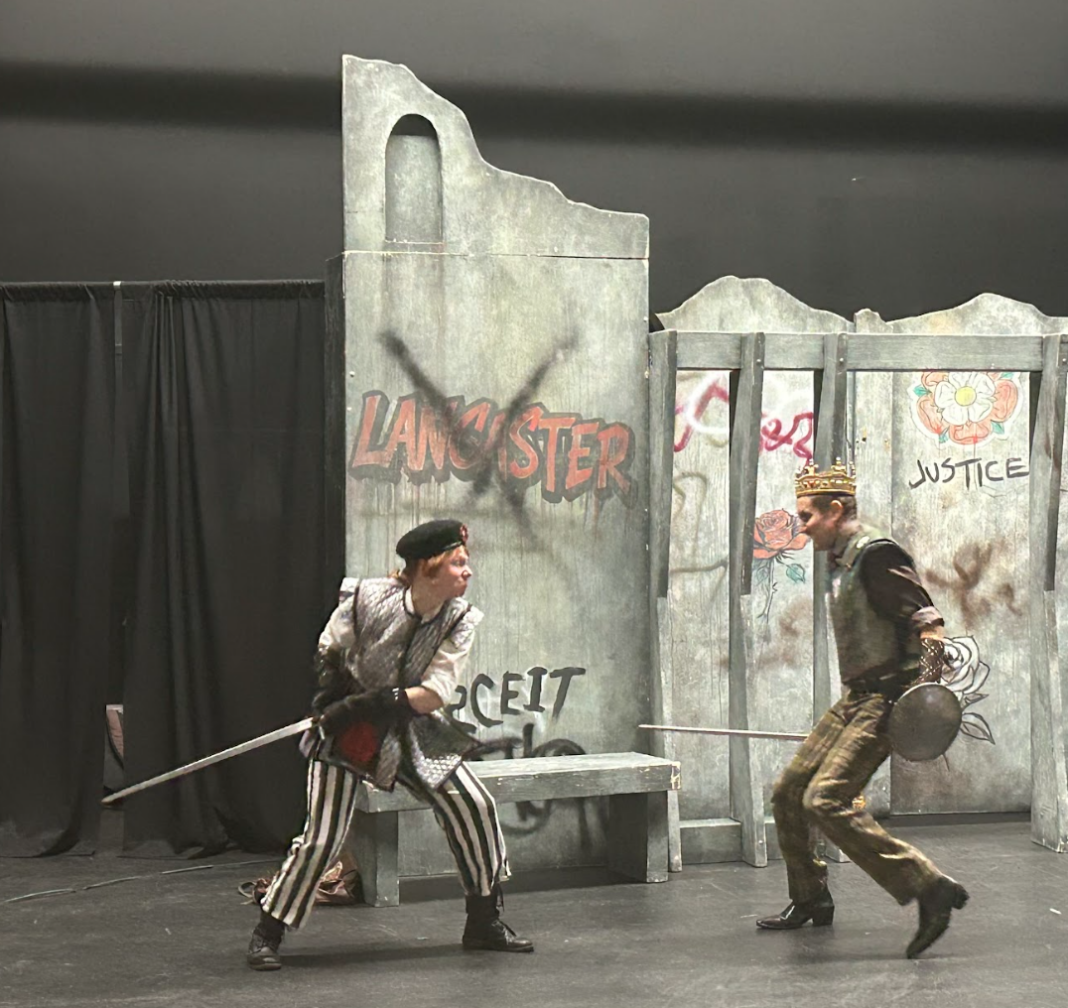


“What separates a good leader from a good person?” Shakespeare in the Schools actor Evan Joslyn asked an East Helena High classroom after the troupe’s Dec. 8 performance of “Richard III,” about a nobleman who manipulates and murders his way to the English throne.
Richard, Duke of Gloucester, spreads false rumors about his rivals to turn public opinion against the rightful heirs – before having them murdered. His deceitful reign eventually collapses when a challenger, the Earl of Richmond, defeats him in battle.
The show and follow-up discussion were part of a months-long tour of more than 50 Montana and Wyoming schools. Directed by Riley O’Toole and presented through Montana Shakespeare in the Parks, Shakespeare in the Schools’ (SIS) first staging of one of the playwright’s histories repeatedly touched on some of today’s hot-button issues: online misinformation, manipulation and questions of truth versus power.
The actors performed in the school’s common area, a vast hall where bleachers had been set up. Throughout the show, they brought scenes of deception into the audience. At one point, students found themselves part of the crowd being swayed by Richard’s lies. Many cheered along as Richard and his ally Lord Buckingham made their case against the young princes, caught up in the passion of their argument.
The production included contemporary touches for its teen audience. Graffiti covered the set walls, giving the stage a modern look. And a screen displayed scene-setting images throughout, helping transition between settings like the Tower of London and city streets.
SIS actor Isa Grofsorean, a Michigan native playing Queen Elizabeth and three other characters on her first tour with the troupe, pointed out how student audiences had repeatedly linked Richard’s manipulations to their growing concerns about increasingly powerful artificial intelligence tools.
“With all the AI stuff, sometimes things seem really real and they’re not at all,” Grofsorean said before praising the students. “They’re so smart, and they give me hope.”
Joshua Henry Brelsford, a New York City actor who played Lord Stanley, Brakenbury, and a bishop, said students often see parallels between navigating Richard’s deceptions and navigating social media and online information. The play’s questions about truth and power feel urgent to teenagers growing up in a digital age, he said.
For 33 years, SIS has prioritized performing in smaller communities and schools without theater programs. Each troupe stop includes a show, a question-and-answer session and workshops that meet Common Core standards in English language arts and literacy.
Over the past year, SIS has performed at youth correctional facilities, small rural schools and larger high schools. “I came from a very artistic town, so I had those resources and got to see so much art,” Grofsorean said. “When you go into these rural areas, it’s really eye opening to realize just how important it is.”
Brelsford recalled the show at Pine Hills Youth Correctional Facility in Miles City as especially memorable. During a civics workshop there, a student connected deeply with Richard’s final monologue, where the character grapples with the terrible things he’s done.
“They had done horrible things, and they felt like they were unforgivable,” Grofsorean explained. “But their teachers told them that they had good in them and that they could be good. And I think experiences like that remind you how important it is to bring this story to those places.”
East Helena High students could participate in workshops in civics, stage combat, or acting. Actors Haley Basil and Giuseppe Michael Pipicella taught the stage combat workshop in the auxiliary gym, where students learned the fundamentals of theatrical fighting.
After a warmup about consent and nonverbal communication the actors demonstrated techniques, using wooden dowels as swords: the difference between a slash, a cut and a parry. Students choreographed their own fight scenes, creating characters and motivations for their conflicts. Grace Morrow, a ninth-grader, partnered with Basil to stage a battle.
“I am a king and she is a little gremlin, and she stole my gold coins – which were secretly chocolate – so I killed her,” Morrow said, explaining the story behind their fight scene.
The actors consistently reminded students that communication, consent and safety form the pillars of stage combat, lessons that also extend beyond the stage. In a classroom, Joslyn and Grofsorean led the civics workshop, asking students to think critically about leadership and power.
They organized students along a continuum to debate key questions: Did the play have a happy ending? Was Queen Elizabeth’s ending happy? What about England as a nation?
Students split over whether the ending brought true peace. One on the “agree” side said Richard’s defeat was good for England because he’d been a tyrant. “Just because Richard was the main character doesn’t necessarily mean that his character is good or must be liked,” he said.
Another pointed out that it depended on whose perspective you took.
The SIS actors then asked students to elect a leader for England from among the play’s characters. Five candidates emerged: the mayor, Lady Rivers, King Edward, Lady Anne and Prince Edward. Students broke into groups to argue for their choices.
Lady Anne, some argued, was strong and independent. King Edward had already ruled and showed mercy by trying to spare his brother. The mayor had brought people joy. Prince Edward understood from a young age the reality of power. Lady Rivers understood the royal family.
The workshop ran out of time before students could elect a ruler, but the exercise encouraged them to think about what qualities matter in leadership. In a play where the villain succeeds by marrying power and manipulation, students had to grapple with whether good leaders need to be good people.
“So many of the characters in the play just let it happen,” Grofsorean said. “They follow [Richard] and they only choose to see what’s on the surface level without really digging deep into the situation or thinking about the repercussions. Don’t sit back and let things happen in front of you. Stay alert and care about what’s happening, because it impacts all of us.”