


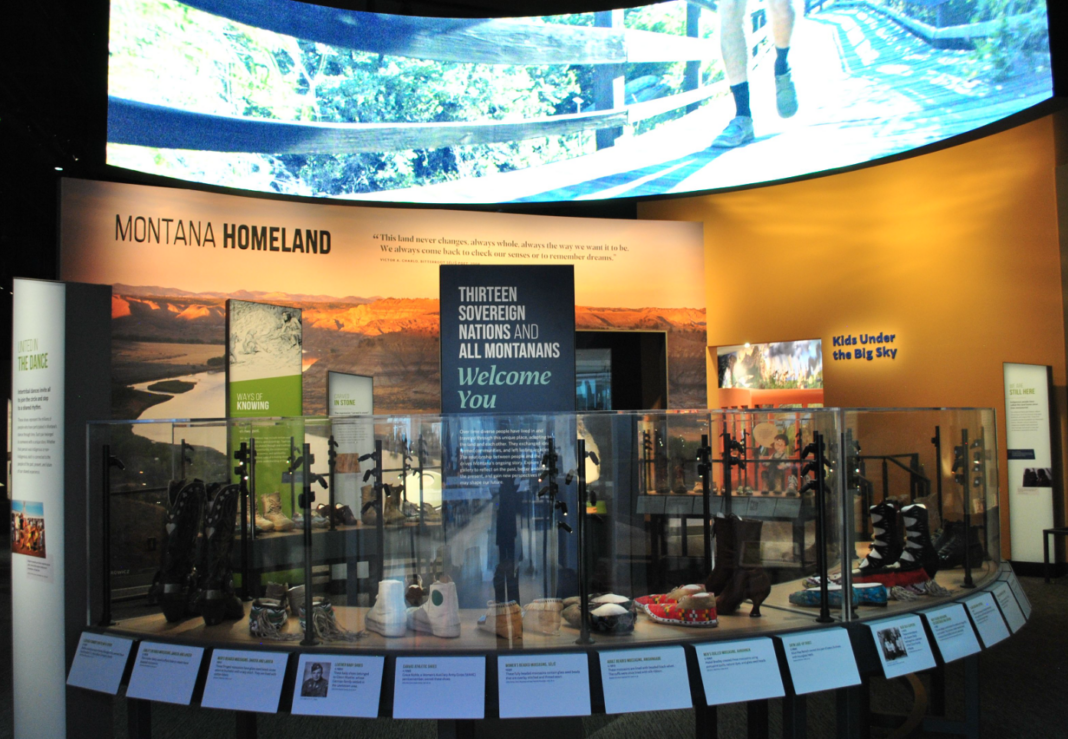


Starting a museum exhibit with shoes seems, initially, an odd choice – especially when those on display look quite similar to the modern-day iterations with which we’re all familiar.
Arranged around a large circular display with toes pointing toward the center, each pair sits next to a plaque explaining who wore them, what they’re made of and the relevant time period. I walk around the circle before I see the sign explaining that the shoes represent an intertribal dance, a powwow tradition in which all tribes and peoples are invited to participate.
It’s then that I realize the canvas nurses shoes from the 1930s, the beaded moccasins from the 1800s, and all the rest are arranged as if ready to join together in the beat of a shared history, regardless of origin or heritage.
Above the shoes, a screen shows shots of people walking over various surfaces with the phrase “Every step has a story.” The footwear display that opens the Homeland exhibition at the Historical Society’s new Heritage Center represents a moving first step in the story of Montana.
After nearly two decades of planning, including five years of construction, the center opened to the public Dec. 3. The angular concrete building designed to be reminiscent of a glacier houses a history exhibit, the Charles M. Russell Gallery, a rotating exhibition space, archival displays, conference rooms, a cafe, a gift shop, and a smudge room, or sacred place of healing where visitors can reflect before entering the galleries.
The $107 million project was funded by the state via the Montana Museums Act, bonds, and $60 million in donations, including 1,300 small donor contributions. The new facility almost doubles the Historical Society’s exhibition space, adding 70,0000 square feet to the building.
Historical Society President Tim Fox expressed delight at being able to display more of the society’s vast collection and predicted renewed public interest. “What I think this will be is a renaissance in interest in Montana history,” he said. “I think it’ll bring us closer to people.”
A 2016 report by the University of Montana’s Bureau of Economic Research estimated that the Heritage Center could bring nearly 80,000 more annual visitors and $7.5 million in revenue to the capital. For Historical Society Director Molly Kruckenberg, the center has always been about more than just history lessons; the goal is to cultivate civic and community engagement.
Through a $50,000 Blue Cross and Blue Shield grant, for instance, the society hopes to create a fund that would enable every school-age Montana child to visit the new facility for free.
“From the very beginning, we wanted a building that was community-centered,” Kruckenberg said in an interview the day after the opening. “A place that you could come in and be comfortable in – if you were just walking through, if you’re getting a cup of coffee, if you’re shopping, if you just have an hour to stop and let your kids play in the children’s gallery, or you want to spend all day here.”
The idea, Kruckenberg added, is “for people to be surrounded by our history and culture at the same time.”
That vision is being realized. I’ve spent nearly eight hours at the center since it opened and there’s a steady bustle to the place: grade-school kids dragging their parents by hand from exhibit to exhibit; workers setting up black tables for an after-hours event in the main hall; and once, the deep beats and powerful voices of an apparent drum circle.
Within days of its opening, this new arts center dedicated to the echoes of Montana’s past already feels alive with the persistent rhythm of the present.
“This isn’t just brick and mortar and steel,” Fox said at the Dec. 2 ribbon-cutting. “This embodies the soul of who we are as Montanans, where we’ve come from and where we’re going.”
Walking through the Montana Homeland exhibit, which details the history of this land from the Ice Age to the 21st century, I’m struck by how apt that sentiment seems. I’m pulled in by immersive experiences on all sides. “Immersive” seems to be a buzzword for modern museums, which must compete with the ever-increasing demands on our attention.
“We can’t put our heads down and say the world hasn’t changed,” said Curator of Exhibits Aaron Genton. “People’s attention spans and how they feel about you can just think about things like screens and technology and how that’s changed our world.”
Today’s museums are walking this tightrope with varying degrees of success. I once visited one with few artifacts, but wall-to-wall computer screens visitors could tap to hear historical figures speak. The experience felt as rewarding as watching the History Channel.
The Heritage Center curators sought to engage as many people as possible via sound, tactical experiences, and even a minor optical illusion. At the start of the Homeland exhibit, signs encourage visitors to touch replicas of prehistoric animal bones. Rarely are we able to touch things in a museum: to clamber into a 1950s sedan stuck in prairie gumbo or sit at a homesteader’s kitchen table. It’s like briefly stepping back in time.
“There’s no real substitute for an experience like this, because we do deal with three-dimensional objects, but we can give people a little bit of both [immersive and traditional experiences], and hopefully catch different people in different ways,” Genton said.
Sounds lure visitors into the past, with each new era heralded by a soundscape shift. The rustling of bears and buffalo gives way to an Irish jig and the lapping of water against a steamboat hull. These changes are subtle, but make the passage of time impossible to miss.
The most impressive example of immersive history is the mineshaft experience. Using colorized archival footage, a video shown on all three of the room’s walls and ceiling puts the viewer inside the grueling life of an early 20th-century miner. Everything in the video, except the layers of earth shown between scenes, is real, from the miners to their mules.
To begin, the viewer steps into a small room with a metal floor meant to resemble an elevator miners rode to work each day. When you’re standing on the grate surrounded by the screens to the front, side, and above, it is almost impossible to tell that what you’re seeing is a two-dimensional screen rather than 3-D reality.
The video begins to shift downward and the “elevator” floor vibrates, creating a wondrously dizzying sensation of plunging deep into the earth while standing stock still.
On the journey down, old-time miners talk about their lives and work. The recordings feel oddly intimate, like listening to your granddad recalling his youth. Watching the back-breaking work and listening to their ambivalence towards it, the miners feel so real it’s almost as if they’re standing next to you.
The mineshaft experience is clearly a favorite among curators and visitors. But what truly impressed me was the care the curators took to tell all of Montana’s history, the good, bad, and complicated. Everyone’s story is told from the Chinese laborers who built the railroads to connect Montana to the rest of the country; to the Irish miners who shaped the very hills of cities like Butte; to the women who won the right to vote six years before the rest of the country.
“It’s important to weave all those stories into one story, instead of separating it out and saying here’s the main story and these are just side notes, ” Kruckenberg said. “We really want our catalog to emphasise the understanding that we’re all Montanans, and we’ve all called Montana home.”
This effort is most noticeable in the presentation of Indigenous history. Rather than relegated to some dark corner of Montana’s early history and abandoned after Manifest Destiny, their struggles and triumphs are integrated into many exhibits alongside loggers, miners, and homesteaders. This is the result of a conscious effort.
Before the center broke ground in 2020, the Historical Society reached out to the state’s 13 sovereign nations to ask for their input. For five years, representatives from each nation joined a weekly Zoom call to discuss how the museum could tell a more complete history.
Input from the nations informed which artifacts went on display, a redesign of the ceremonial smudge room, and shaped the design of building’s eastern side, which pays homage to the sacred place the direction holds for several Indigenous cultures.
“We wanted to be able to tell our story from our viewpoint, from the inside, looking out for a change, instead of somebody writing about us,” said Darnell Davis Rides at the Door, a Pikunii (Blackfeet) historian and educator who served as the Blackfeet Nation representative to the museum along with her husband, Smokey.
As I walked through the exhibit, I thought of the catchy narratives of School House Rock, songs like “Elbow Room” and “The Preamble”. Those early history lessons in American Triumphalism seemed almost callous as I gazed at the images weaved into an 1895 story cloth: Indigenous people hunt buffalo and elk while along the cloth’s edge, blue-uniformed men march forward with rifles raised.
“What details do you see?” asks a plaque next to the cloth. “What kind of stories are being remembered?” Those Schoolhouse Rock songs were incomplete and what a loss that was.
I look at the story cloth again and see resilience. Despite the incursion of abusive change, the story is about life. A similar resilience inspired miners to unionize despite great pressures and formerly enslaved people and women to create homesteads.
Smokey, of the Blackfeet Nation, thought the museum could be the starting point for greater understanding. “We can give our children a different mentality,” he said.
The Heritage Center, at 225 Roberts St, is free of charge and open to the public seven days a week, usually from 9 a.m. to 5 p.m. Learn more at https://montanamuseum.org/.