


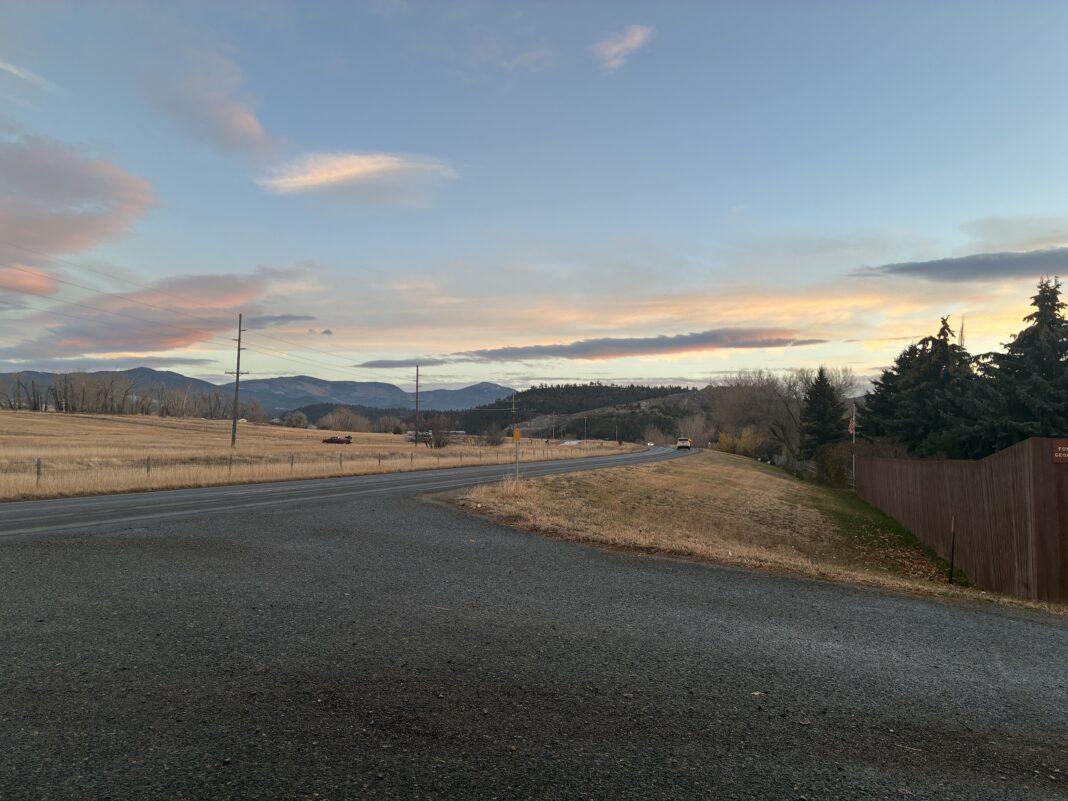


Dan Jenkins was grilling steaks at Trout Creek Canyon when his neighbor pulled into the campground lot bearing bad news: a speeding sedan had lurched off the highway and smashed through Jenkins’ backyard fence.
“I had to drink several beers after that,” joked Jenkins, who lives with his wife in Sunnybrook Estates, a Montana City subdivision along secondary state Highway 518.
This two-mile stretch of two-lane road is one of the area’s more dangerous non-interstate byways, with a crash rate nearly four times the state average, according to a recent analysis by The Montana Free Press.
Highway 518, a busy Helena detour linking Montana City to East Helena from Interstate 15 to Highway 287, saw 44 crashes from 2019 to 2023, according to Montana Department of Transportation (DoT) data. That’s nearly 500 accidents per 100 million vehicle miles traveled in a state where the average is 134 – and Jenkins is well aware of the dangers.
After the 2019 crash that destroyed his wooden fencing, Jenkins replaced the fence corner with metal sheeting, then painted it to match the rest of the fence. Three other cars have since driven off 518 and crashed into trees lining his fence.
To create more of a barrier between his home and the perilous stretch of highway a few meters away, Jenkins has laid down boulders and encouraged cottonwood trees to grow where he would have otherwise cut them down. His neighbor reinforced his own fence with concrete bases after a rogue vehicle crashed through his previous fence and rumbled into the yard where he often plays football with his grandson.
Montana had the U.S.’ fifth most fatal car accidents per capita in 2023, according to MTFP, with most crashes happening outside cities. A report from The National Highway Traffic Safety Administration (NHTSA) and TRIP, a national transportation nonprofit, estimates that fatal and serious traffic crashes in Montana in 2024 caused $6 billion in social harm, including reduced quality of life from chronic pain and lifelong physical impairments.
One issue on this stretch of 518 is wildlife. “There are also a lot of animal crossings, so I think it does make that a little bit more dangerous,” said Sunnybrook resident Shemaih Clark, recounting the beavers, deer, moose, and mountain lions she’s seen in the neighborhood.
That’s no surprise. A stone’s throw away, I-15 from Montana City to Clancy is one of Montana’s busiest animal crossings: a stretch of road with the state’s highest risk to human safety and property damage due to wildlife-vehicle collisions, as The Monitor reported in September.
Yet local fauna aren’t the only problem on 518. “If there’s a dangerous road, a lot of times it has to do with the geometry of the roadway,” said Brian Pfeifer, a road safety engineer and the CEO of Qforensics, an accident reconstruction firm.
Sharp curves, blind turns, hidden entrances, and poor signage are often problematic, according to Pfeifer and other analysts. Secondary state Highway 279, which is also known as Lincoln Road and pours into East Helena from the northwest, has an accident rate more than four times the state average.
This may be due to hairpin turns on up-and-down stretches through mountains and a narrow roadway originally built for homesteader carriages. Lincoln Road is slated for a major redesign in 2028, according to the DOT, which plans to reduce hazards by improving alignment and building wider shoulders to accommodate future Helena Valley growth.
Such road fixes tend to be worth the cost. The AAA Foundation for Traffic Safety asserts that better roadways could eliminate 350,000 injuries and save nearly 63,7000 lives nationwide over two decades. Sunnybrook residents envision an array of possible improvements for Highway 518, including caution signs.
Several Sunnybrook residents mentioned the 65 mph speed limit as a problem, especially with one of the subdivision turn-offs coming after a sharp curve. “I wish people would just slow down,” said Don Wetzel Jr., mentioning the speed of many cars headed north from Montana City.
About a year ago, his wife, Kesley Wetzel, was almost rear ended while turning off 518 into the neighborhood. The driver behind her failed to see Wetzel’s car slowing until it was almost too late, then swerved into a ditch and crashed into a fence on the east side of 518, across from Sunnybrook. Wetzel suspected the driver was looking at her phone right before the accident.
This highlights the growing problem of distracted driving, which boosts the danger posed by high speed vehicles. Distracted drivers killed more than 3,000 Americans in 2019, nearly 9% of that year’s road fatalities, according to federal data.
After a friend was rear-ended waiting to turn into the neighborhood, Jenkins’ wife called the DOT requesting better signage or a reduced speed limit to improve safety. The official said the department would take a closer look. Nothing has changed in the several years since.
The Monitor reached out to the Montana DOT for comment but did not hear back in time for publication. Pfeifer, the highway forensics analyst, said road changes tend to occur at a glacial pace. “It’s difficult,” he said. “Usually, you have to go through traffic studies and a lot of things have to happen.”
Pfeifer added that limited visibility and a lot of collisions often draw the attention of road safety managers. John Lazzara, Transportation Market Leader at the engineering firm Stanley Consultants, concurred, explaining that a safety examination looks at intersections, speed management, roadway departures, bikes and pedestrians, and the ways that those might intersect.
For residents of Sunnybrook, the blind vertical curve and the speed limit of 65 mph seem to be the key concerns. Addressing the first issue could involve altering the shape of the road, which would be a major project, while reducing the speed limit would likely be an easier fix. But Lazzara pointed out that nearly any roadway change involves a feasibility study, community outreach, and applying for funding.
Several times, Jenkins and his neighbors have leapt into action as first responders. They have called 911 and brought water and blankets to stunned drivers and passengers clambering out of damaged cars.
Jenkins, a former U.S. Navy officer, has helped change tires as drivers shakily called their boss to say they wouldn’t be in to work that day. This reflects accidents’ impact in terms of lost productivity; there’s also often property damage, and insurance, administrative, and legal costs.
This is in addition to a troubling knock-on effect on lifestyle. Sunnybrook residents enforce careful regulations on young children, barring them from crossing the highway on their own or riding their bikes to East Helena, two miles away. Parents tend to be strict with new drivers, giving careful and detailed instruction due to the clear danger.
“I have a young driver, he’s taking Driver’s Ed,” Kelsey Wetzel said of her son, a Jefferson High freshman. “So it’s like, be careful. Double, triple check both ways.”
Traffic on 518 is set to rise sharply in the coming years due to coming subdivisions, including as many as 6000 homes planned for the former ASARCO lands on East Helena’s southern rim, a couple miles up the road.
“I just feel like it’s gonna get busier and busier,” worried Kesley Wetzel.
Lazzara thought residents might be able to do more, such as reaching out to the state DOT, as well as elected officials. “If their constituents are saying, ‘Hey, we got an issue,’ usually there’s a path to at least having further conversations about it,” he said.
Residents hoped authorities would soon take action to boost safety on this dangerous stretch of roadway. Jenkins feared change would only come in the wake of a tragedy.
“It’s gonna be a fatality,” he said, standing by the boulders that protect his home.