




The Trump Administration on Tuesday threatened to halt the main federal food assistance program until the end of the government shutdown, potentially reversing the previous day’s announcement that the government would provide partial SNAP funding this month.
However this plays out, locals outside the Helena Food Share expressed disdain for the political in-fighting in Washington and feared the impossible choices they may soon face.
“That money I’m going to be spending on groceries [means] I’m going to be running out of water,” said Boulder resident Monty Auch, who recently got SNAP after his divorce.
With renewed Supplemental Nutritional Assistance Program (SNAP) payments expected to be delayed from “a few weeks to several months,” according to a U.S. Department of Agriculture official, the roughly 77,000 Montanas on SNAP will likely be left in a dangerous limbo.
Auch expects to soon choose between feeding himself or paying bills. “I don’t know how that’s going to work,” he said, blaming the Democratic Party for Congress’ failure to pass the government funding bill. “It’s like trench warfare for these people,” he added. “Maybe the right thing to do is to be considerate of the constituency who vote for you – or in this case, I won’t.”
This is the first time a government shutdown has interrupted SNAP benefits for the 41.7 million Americans who rely on the program. Under Monday’s partial funding plan, the USDA would use $4.65 billion of its contingency reserves to fund SNAP, or just over half of the program’s monthly $8 billion outlay. The decision came after two federal judges ruled that the White House could not withhold funds from SNAP in case of a hypothetical emergency the administration argued would be a better use for contingency funds.
Lewis & Clerk resident Chariot Ford had never visited her local food share before Monday, but without SNAP, she had no choice. Shivering in the early twilight, she clutched a bag of raisin bagels close to her chest and thought of her three children. “I’m worried my kids won’t have breakfast or dinner,” she said. “It’s scary, actually.”
Lewis & Clark resident Judy Williams was also worried about the coming weeks. “[SNAP] means me eating fairly decently for at least half to three quarters of the month, “ she said. ”Otherwise, you know, this month I don’t get anything.”
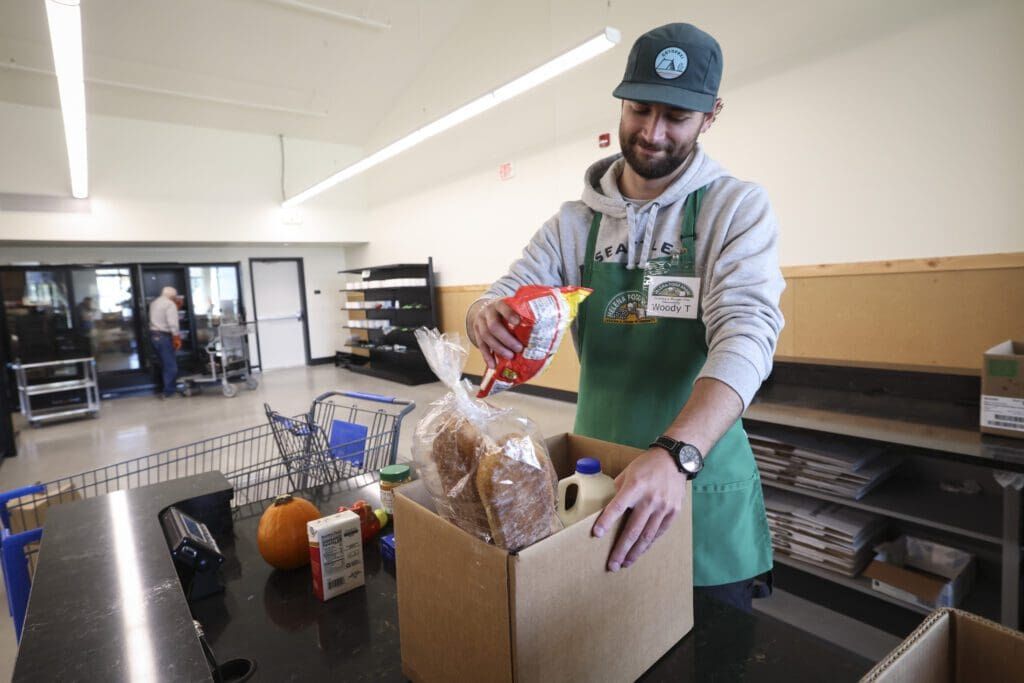
Even if she gets half her usual SNAP check this month, Williams is worried about the intervening weeks and will depend on Helena Food Share to fill the gap. The charity is working to help the nearly 5,900 SNAP beneficiaries in surrounding counties, including 543 in Jefferson.
Last month, the food share provided food to 900 SNAP beneficiaries, but Communications Director Patty White expects that number to increase as people who normally buy food through SNAP turn to alternatives. The organization has seen a steady increase in visitors over the last couple of years, but the growth has accelerated since the government shutdown: more than 100 new households signed up for benefits last month.
The food share has seen its participation increase by more than 28 percent since moving into a larger facility. “We must meet the need at the door,” White said.
Some states have vowed to use emergency funding to bolster SNAP resources, but Governor Greg Gianforte last week refused to tap into Montana’s $268 million in emergency funding. The governor instead called on Senate Democrats to pass the funding bill. Jolene Goulbert, a Lewis & Clark resident SNAP beneficiary, called the governor a “coward” for shunting the blame and swore not to vote for him in the future.
In the Helena Food Share parking lot Monday afternoon, people were sad, scared, and angry. Some blamed the Democratic Party, others the Trump Administration, and still others Governor Gianforte. But they all felt misused by elected officials. “We’re political fodder,” said Auch.
Even saving money by continuing to visit Helena Food Share presents its own problems. Auch is worried about the cost of gas he’ll burn driving to Helena every week. Jefferson County has its own food bank, the JeffCo Food Share, but it’s only open on the second Thursday of each month.
For many, SNAP benefits aren’t just about getting food on the table, but the surest route to nutritious meat and vegetables they would otherwise struggle to afford. Ford views that nutritious food as crucial to the health of her three children.
Ford spent Monday morning explaining to her 10-year-old daughter that she would have no snacks at school that week. She said her daughter felt sad and confused and expected to feel alienated at school because she couldn’t bring food from home. “She asked why other kids who have more money got to have more for dinner and she had hardly any,” Ford said.
Many SNAP beneficiaries plan to lean on friends and family for help. Ford, who works as a private senior living assistant, hopes to barter her services for some of the meat her clients keep in their freezers. A U.S. Army veteran, Ford said she feels abandoned by the government.
Williams similarly felt used by political officials and their tussles. With her eyes welling up, Williams looked ahead to winter, fearing other federal programs like the Low Income Home Energy Assistance Program (LIHEAP) might be next.
“The government doesn’t care,” she said. “They don’t care.”
Donate to Helena Food Share on their website or donate food from 8:30 a.m. to 6:00 p.m. Mon-Thurs at 1280 Boulder Ave, Helena. Donate to the Jeffco Food Share at P.O. Box 244, Boulder, MT 59632, and the Whitehall Food Pantry at P.O. Box 266, Whitehall, MT.