


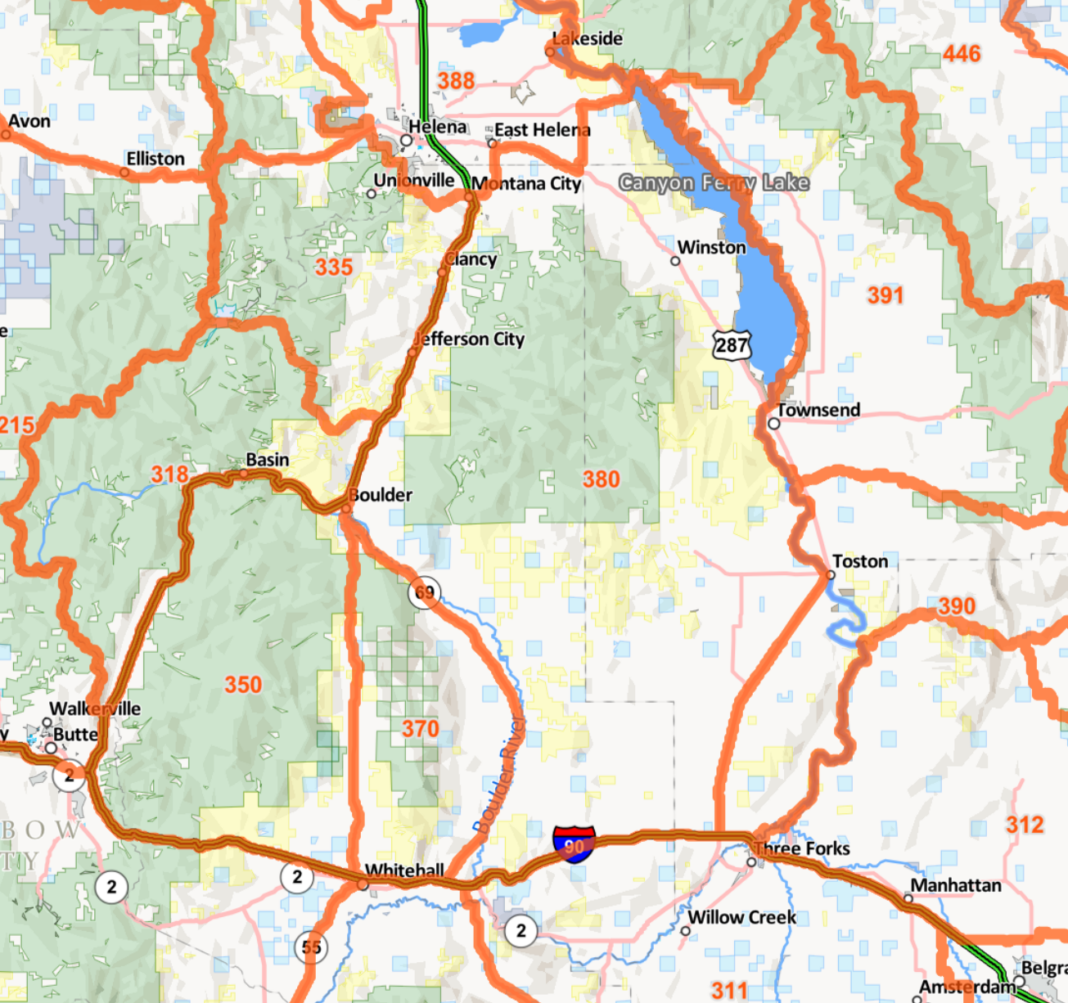


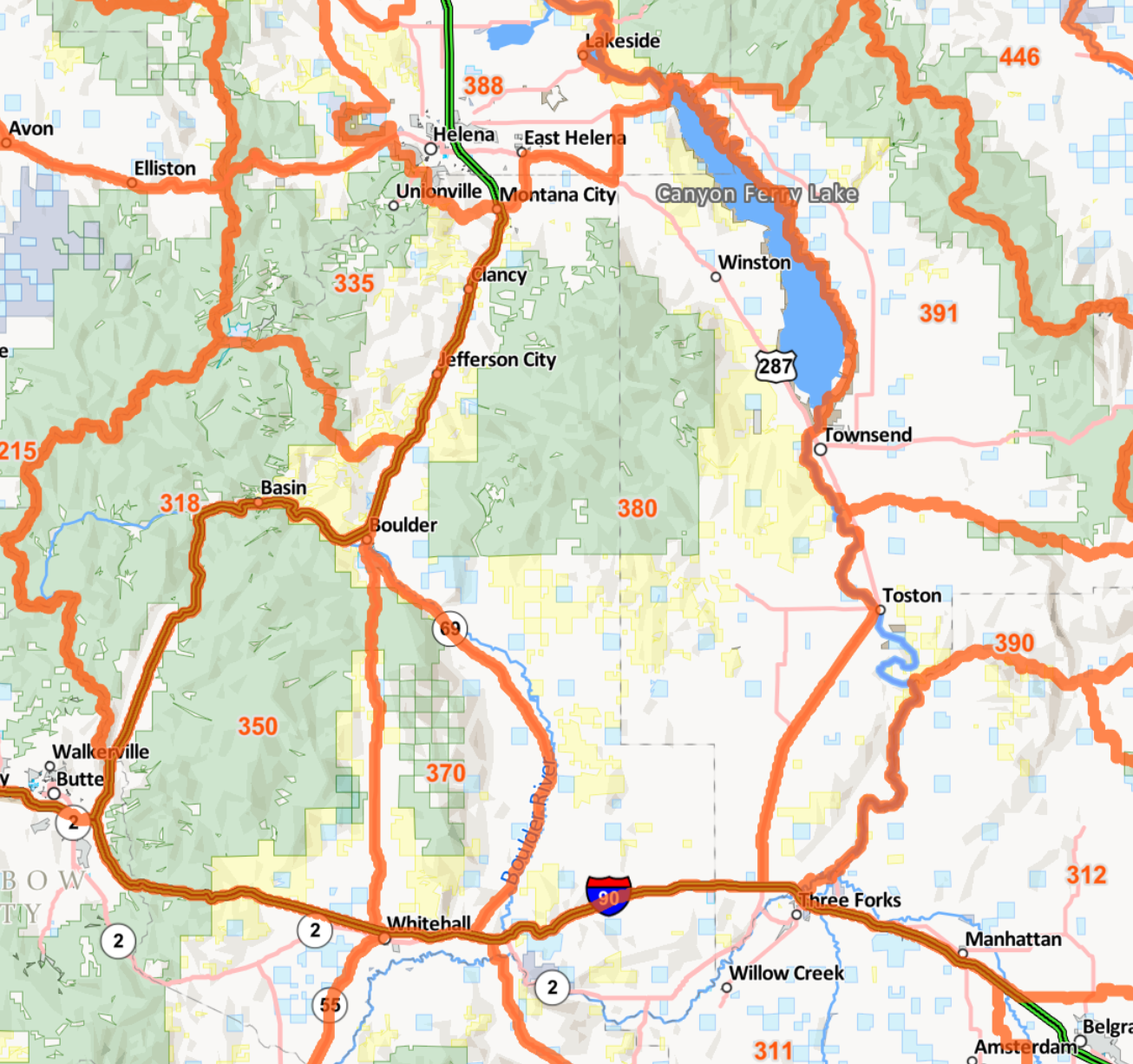
A map of Jefferson County hunting districts, courtesy of FWP.
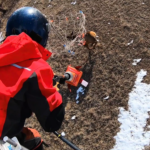
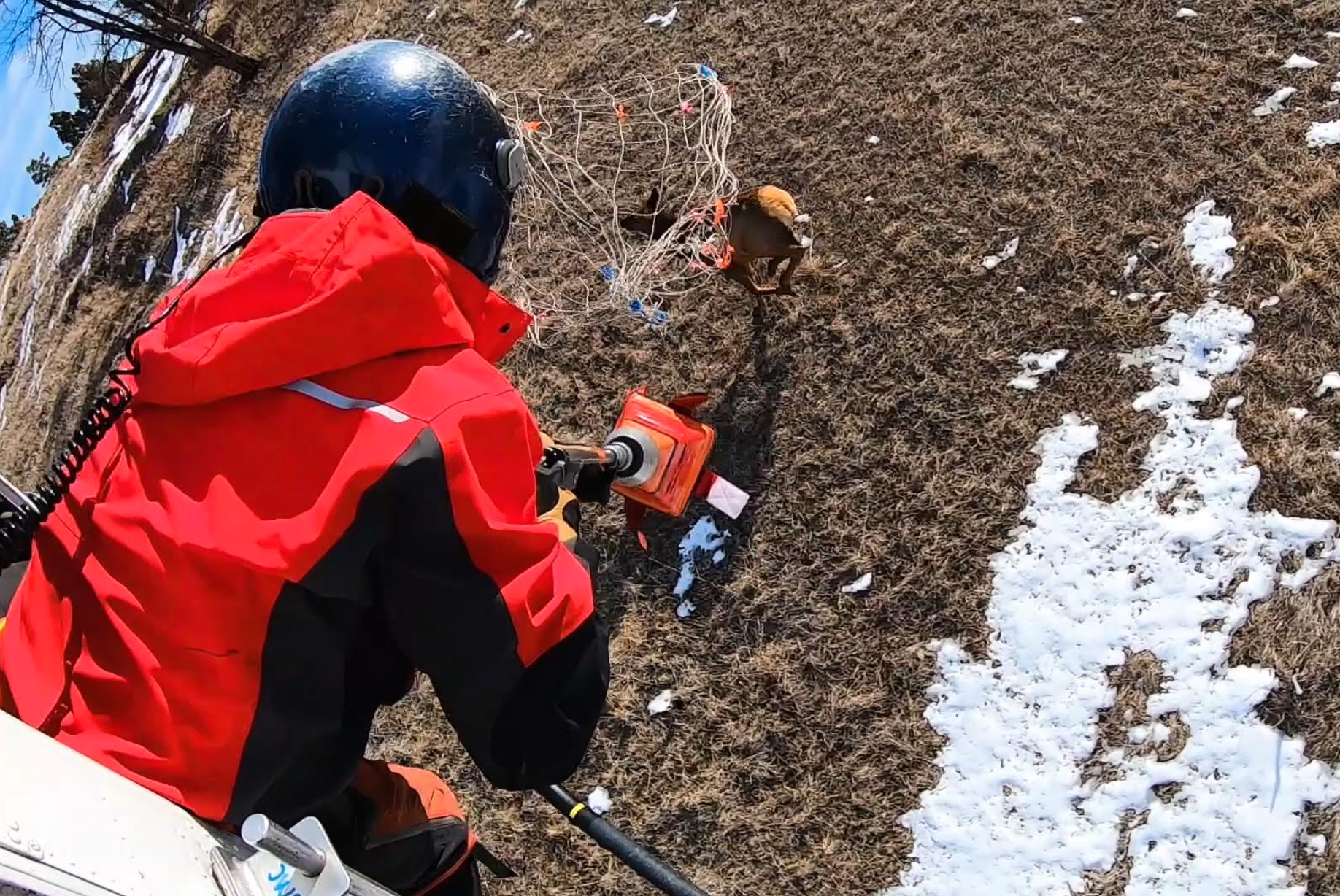
FWP official shoots net at an elk in eastern Montana in 2021 (courtesy of FWP).
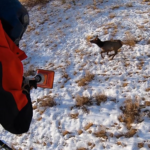
Leaning out of a helicopter, an FWP official trains his net-gun on an elk in eastern Montana in 2021 (courtesy of FWP).
What are the seasonal movements of the elk herd that ranges across Helena’s South Hills, the Elkhorns, and the Boulder Mountains? Where do they tend to winter and might they need help crossing the interstate?
These are among the questions Montana Fish, Wildlife & Parks’ officials hope to answer after collaring 60 elk cows this coming winter and tracking their movements for two years from the Elkhorn Mountains (Hunting District 380) to the Boulder Mountains (HDs 318 and 335) and further west toward the Continental Divide and Deer Lodge (HD 215).
This will mark the first large-scale FWP study of this herd’s movements in the Boulder Mountains area stretching from Basin to Unionville, and the first ever to examine its Interstate 15 crossing habits.
Beyond identifying potential highway wildlife crossing locations, FWP hopes to better understand elk movements and segmentation in these areas and accordingly align its Elk Management Plan and hunting recommendations.
“An elk population, or even a ‘herd unit/segment,’ isn’t one large group of elk that stays together year-round, but instead is comprised of many different smaller groups of elk of different age and sex classes that use a HD or given geographic area,” explains FWP’s Townsend Area Wildlife Biologist Adam Grove, one of three co-leads of the study.
This elk collaring project seeks to gain a clearer picture of the seasonal movements of smaller segments within this unit, or herd. “A primary purpose of the upcoming study is to get a better understanding of how many elk may be crossing I-15,” added Grove, “and if they are crossing the interstate, when are they crossing.”
This data is expected to help the Department of Transportation, county officials, and wildlife conservation groups better prioritize locations along I-15 for wildlife accommodations, in line with new legislation that funds such projects.
In addition, FWP expects the study to more accurately reflect the number of elk in various hunting districts throughout the year, ensuring better population maintenance.
For HD 380, for instance, FWP annually issues, via an April lottery draw, around 100 either-sex elk permits – the only permits that authorize brow-tined bull hunting in the district. But is that the appropriate total?
“You don’t want to make a hunting season recommendation based on 1,000 elk observed during a winter survey in a HD when there are only actually 500 in the HD during the hunting season,” explained Grove. He also mentioned the reverse, adding that this could “lead to potentially harvesting more or less elk than desired.”
This is crucial information because HDs 318 and 335, west and north of I-15, are popular with elk hunters, while HD 380, east of 1-15, where this herd often roams, is widely seen as Montana’s premiere destination for trophy elk.
“The Elkhorn Mountains are still the most coveted tag in the state and for good reason. There are plenty of bulls here,” says Dan Pickar, a hunting advisor for Eastmans, a top online forum for hunters. Of the Boulder Mountain area, he adds: “It’s classic elk habitat with pines and open parks and plenty of sagebrush.” (In FWP’s most recent elk count, last year, HD 318 had 698, HD 335 had 1442, and HD 380 had 1601.)
In January or February, FWP officials will capture some 60 cow elk, mainly in HDs 318 and 335, and outfit them with GPS collars that provide location information six times per day.
“We will use aerial net-gunning from a helicopter to capture elk, which can be quite efficient when elk are in open landscapes,” said FWP Research Wildlife Biologist and project co-lead Chris Hansen. “Captures will hopefully only take a few days.”
Data collection will then begin, expanding the knowledge gained from the most recent FWP study of this herd, in 2015-18, when 35 cows and 25 bulls in HD 380 were collared to examine how a mountain pine beetle epidemic had impacted their habitat.
That study found the elk had reduced their use of areas that had lost lodgepole pines due to the beetle and that males were frequenting higher elevations and denser canopy, further away from roads.
FWP’s understanding of this herd’s migrations and segmentation is based in part on a large-scale study from 1982 to 1992, when some 300 elk in HD 380 were fitted with very high frequency (VHF) collars to determine distribution and movement patterns.
Two FWP studies in the 1980s involved elk collaring in HD 318 and 335, but they were both small and focused on habitat and the impact of a new powerline. This winter’s project is, thus, an unprecedented study of elk movement and segmentation in the Boulder Mountains and the initial survey of the herd’s I-15 crossing habits.
As with the FWP’s annual elk count, collaring is done in winter as that’s when visibility is best, thanks to the bare trees and snow cover, and when elk bunch together and tend to remain in lower elevations, where food is accessible.