






East Helena Mayor Kelly Harris (Courtesy of Kelly Harris).
A look at East Helena’s Valley Drive.

East Helena High Vigilante pride downtown (Aleka Kroitzsh/The Monitor).
This article was updated with new Mayor Harris comments in Nov 2025.
It’s rare for a town to go from a dark place to belle of the ball in just a few years, but that may be the best way to describe East Helena’s journey – from shrinking and scandal-plagued to Montana’s fastest-growing city set to embark on an almost unfathomable boom.
When Kelly Harris first ran for mayor in 2021, 20 years after the shuttering of the ASARCO smelter, East Helena seemed at a low ebb. The city’s population had contracted some 18 percent over the past dozen years and the new high school, having just opened, had yet to make its mark. Then the police chief was found to be distributing child pornography (he was later convicted and sent to prison), leaving local law enforcement in tatters.
Fast forward four years and East Helena is the state’s fastest-growing city by percentage for two years running and East Helena High has won a state sports title and is now mulling expansion, helping renew town pride. Two new subdivisions (Highland Meadows and Vigilante) totaling 420 homes are nearing completion and the city plans two larger developments expected to add up to 5500 homes over 20 years – and quintuple its population.
“We’re starting to see that growth and development now on these former smelter properties that had to go through a clean-up process,” Harris, whose father and uncles worked at ASARCO before it became a Superfund site, said in a recent interview at City Hall.

Yet some fear Lt. Gov. Kristen Juras’s October decision to deny the city’s request for water rights on former ASARCO lands could imperil Helena-area Habitat for Humanity’s 1500-home Rose Hills project and Oakland Developers’ 4500-home Prickly Pear Estates plan.
Harris admitted to being surprised by the state’s decision. “I just don’t understand their position,” he said. “It’s very confusing to me why they’re not on board with our plan for affordable housing – they approved the sales of these lands to developers.”
Yet the mayor sees the water rights issue as far from settled, mainly because the process of shifting the water rights to instream flows will take time. “When they file for these water rights to be transferred, we expect to challenge that,” said Harris, though he wasn’t sure when that might happen.
On the East Helena development front, there’s more. Last year the city received a $10 million federal grant to remake its main thoroughfare, Valley Drive. New Police Chief Mike Sanders seems to have stabilized the police department, a sprawling 240-acre park opened in May, and in early July the City Council approved a $6 million, 11,000-square-foot library.
East Helena High has won its first state sports title and is now mulling expansion, helping renew town pride. “We’re not the smelter town any more, but we have a high school now…and an identity from that,” he added. “Having Friday night lights in East Helena is awesome, going to football games, basketball games.”
All of which helps explain why Harris has already been rubber-stamped for a second term, having been the only candidate to file for the November election by last month’s deadline. Looking ahead, the mayor aims to extend the town’s rebuilt sense of community and ensure the required infrastructure is in place for the coming housing wave. In regards to the first, he’s been working to bring residents together more often.
“What we do is get out of the way, from a government perspective, of local events,” he said, citing the Food Truck Festival and the Car Show on Main Street, both launched last year. “We can’t throw events like a car show, but we can clear away the red tape.”
In October, East Helena’s City Council unanimously approved the Rose Hills project (1500 homes by 2040), which plans to make up to 40 percent of its homes permanently affordable through a land trust. Next up is a review of Oakland’s Prickly Pear plan (4500 homes by 2045), expected by the end of the year.
Harris was not convinced that if East Helena failed to regain the water rights for the ASARCO land it would need to reduce the Rose Hills or Prickly Pear plans. The mayor has given himself a crash course in water rights over the past several years, and has learned a great deal.
His view is that the state has linked its final decision on ASARCO water rights to an ongoing review of water for the entire Missouri River basin, which started in 1984. “The city’s water rights are under review as part of that,” Harris explained. “It’s a process they’re trying to expedite at this point, but it’s complicated.”
The key for East Helena is making sure development is done according to the rules and in the right order. “We absolutely want to make sure this growth is done the right way,” said Harris, starting to tick off infrastructure priorities. “Our biggest issue is we have to update our sewer plant – that’s the top of the list.”
That work has already begun, with the construction of a new headworks facility for the town’s aging sewage treatment plant, partially funded by a $6.9 million loan from Montana’s DNRC. That project is set for completion by spring 2026, after which the city will build oxidation ditches and install an infiltration basin to circulate and aerate wastewater.
Public Works Director Kevin Ore recently toured wastewater facilities in Four Corners and Belgrade to learn what works, what doesn’t, and how to implement in stages. “It’s better to learn from other people’s mistakes than make them twice,” he said, adding that the new plan cuts maintenance costs. “It’s new technology for us, but it’s the way a lot of plants are going.”
With its population tripling, from 5,000 in 2000 to an expected 15,000 by 2032, Belgrade is often cited as a model for East Helena. One thing Belgrade has done is grab more land to build on, annexing more than 2,000 acres in the past five years and doubling the city’s footprint. East Helena, on the other hand, annexed vast swathes of former smelter land nearly 15 years ago and is now only considering further expansion for specific projects.
“We’re not out there trying to grab land at all. We’re land rich,” said Harris, who sees other cities providing certain insights, but prefers his hometown to follow its own path. “I don’t think East Helena wants to be like Belgrade in any way shape or form.”
Next on the mayor’s infrastructure agenda is widening and improving Valley Drive, a former two-lane road through fields that has seen traffic spike in recent years with the addition of a high school and grade school. Early this year, however, the Trump Administration froze the $10 million Valley Drive grant to perform an internal review.
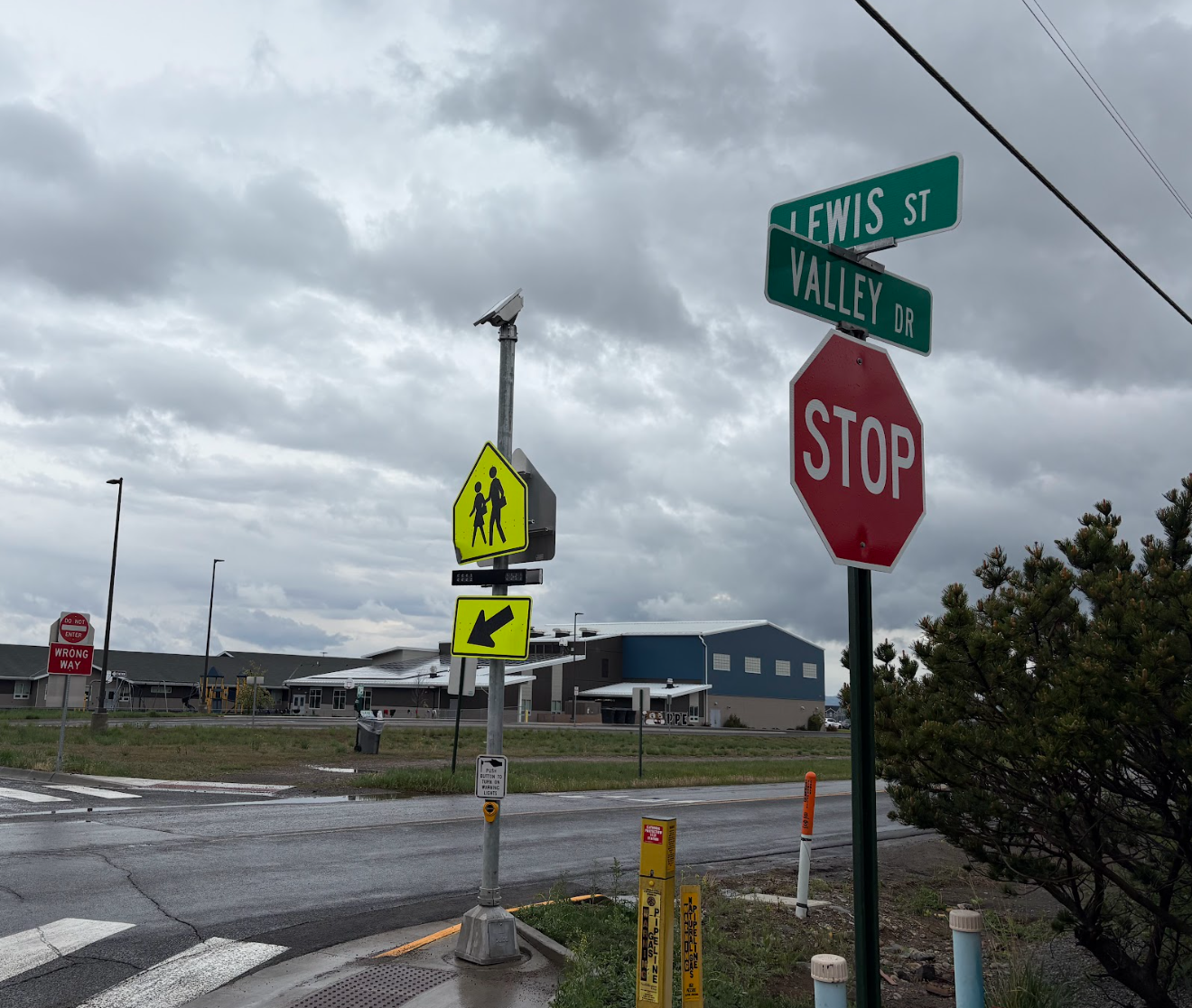
But after filling out the Department of Transportation’s new agreement forms, Harris and Ore felt confident the funds would be released by the end of the year, enabling work to begin. “That’s huge, that’s a big one for us,” said Harris. “We have a $2 million city budget – we can’t build a $10 million road.”
The third infrastructure priority is acquiring water rights from the old smelter site to ensure adequate fresh water for thousands of new residents. The state is reviewing East Helena’s request to transfer the rights, which are under the control of the Montana Environmental Trust Group (METG). Once approved, the issue would go before a water rights court.
Meanwhile, the Superfund clean-up continues. A 16-million-ton pile of jet-black slag, or smelter waste, looms over the town, taking up nearly half the former smelter footprint. Whether it will be capped or shipped away for resource extraction is yet to be decided. In addition, the Environmental Protection Agency recently changed its acceptable level of lead contamination in soil from 1000 parts per million to 400, necessitating the digging up of most East Helena residential properties over the next two years. (Lewis & Clark County is also offering East Helena residents free blood testing for elevated levels of lead.)
Is this former company town ready for the looming boom? Some residents see how lightning-fast growth has shaped Bozeman and Belgrade – sharply increasing traffic and housing costs, for instance – and worry about similar changes in East Helena.
“There are people who have fears and concerns,” said Harris, mentioning two public events the city held earlier this year to discuss the new housing developments. “There are also people who’d like to see East Helena have more stores, more shopping and business and industry.”
Oakland’s plan for Prickly Pear Estates includes space for business parks and light industry, including a possible rail freight operation at the old fairgrounds. Looking ahead to waves of economic development in the coming years, East Helena may want to be wary of overheating.
“You don’t want to put the cart before the horse,” said Harris. “Our police department, our services, our sewer and water, these things have to grow at the right pace and scale.”